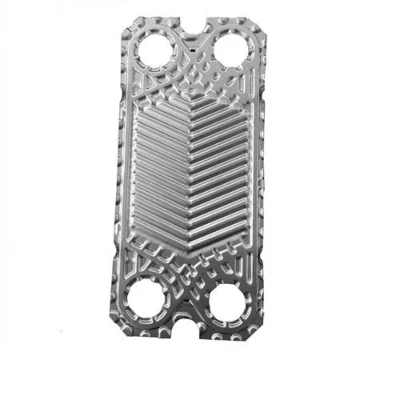
Plate heat exchanger:
A plate heat exchanger is a highly efficient heat exchanger made up of a series of metal plates with a certain corrugated shape. A thin rectangular channel is formed between the various plates and heat is exchanged through the plates. The plate heat exchanger is the ideal equipment for heat exchange between liquid-liquid and liquid-vapour. It has the characteristics of high heat exchange efficiency, small heat loss, compact and light structure, small footprint, wide application and long service life. In the case of the same pressure loss, its heat transfer coefficient is 3-5 times higher than that of a tubular heat exchanger, covers an area of one-third of that of a tubular type, and the heat recovery rate can be as high as 90% or more. Plate heat exchanger is a series of metal sheets with a certain corrugated shape stacked and formed into a highly efficient heat exchanger. A thin rectangular channel is formed between the various plates, and heat is exchanged through the plates. Plate heat exchanger is the ideal equipment for heat exchange between liquid-liquid and liquid-vapour. It has the characteristics of high heat exchange efficiency, small heat loss, compact and light structure, small footprint, wide application and long service life. Under the same pressure loss, its heat transfer coefficient is 3-5 times higher than that of a tubular heat exchanger, occupies one third of the floor space of a tubular type, and the heat recovery rate can be as high as 90% or more.
Structure of heat exchanger:
The plate heat exchanger is mainly composed of two major parts: the frame and the plate sheet, which is made of various materials, is pressed with various forms of abrasives into corrugations of different shapes, and the four corners of the plate are opened with corner holes for the passage of media. The perimeter of the plate and the corner holes are sealed with rubber gaskets. The frame is made up of a fixed pressing plate, an active pressing plate, upper and lower guide rods and clamping bolts. The plate heat exchanger is mounted in the form of a superimposed plate in the middle of the fixed pressing plate, the movable pressing plate, and then clamped with clamping bolts.
The surface of the heat exchanger plate is pressed into a corrugated or groove type to increase the stiffness of the plate, increase the degree of fluid turbulence and improve heat transfer efficiency. Its material is generally: stainless steel, copper, aluminium, aluminium alloy titanium, nickel, etc. The corner holes at the corners of the plate play the role of connecting channels.
Gaskets:
The gaskets are placed around the plate, not only to play a sealing role, but also to form a certain gap between the plate and the plate, thus constituting a fluid channel The temperature that the gaskets can withstand is essentially the working temperature of the plate exchange, and the working pressure of the plate exchange is also governed by the gaskets. The commonly used gasket materials are NBR (nitrile rubber) and EPDN (ethylene propylene rubber), where NBR (nitrile rubber) is used at a temperature below 150°C. The pressure is below 0.6 MPa. EPDN (ethylene propylene rubber) is used at a temperature of no more than 160°C and a pressure of less than 2 MPa. The upper and lower guide rods ensure the positioning of the plate, which is compressed by the end plates.
Working principle and installation requirement:
Removable plate heat exchanger is made of many stamped with corrugated thin plates at certain intervals, surrounded by gaskets sealed by the frame of the heat exchanger plates and gaskets pressed spiral overlapping pressed into place, the plates and gaskets of the four corner holes form a fluid distribution tube and collection tube, and at the same time a reasonable separation of the hot and cold flow, so that it is respectively in each plate on both sides of the pipe flow, through the plate for heat exchange.
Advantages:
1、Compact structure, large heat exchange area per unit volume.
2、Strong adaptability, can meet the required heat exchange area by increasing or decreasing the plate.
3、Small heat loss.
4、Since the plate gap (2~8mm) is small, the material can be passed through quickly and thinly, and the heat exchange temperature can be controlled precisely.
Disadvantages:
1、Because of the limitation of the structure form, rubber gasket must be used, seal around long, not easy to seal.
2、Low pressure capacity (not higher than 2MPa), use temperature (not higher than 180℃) is limited by the temperature resistance of the gasket.
3、Small pipeline, easy to block.
4、High fluid resistance and generally small capacity.
Installation requirements:
1, the heat exchanger should not be deformed, fasteners should not be loose or other mechanical damage.
2、Equipment lifting, lifting rope shall not hang in the receiver, positioning beam or plate piece.
3, the heat exchanger around to leave enough space to facilitate maintenance.
4, hot and cold media import and export receiver installation, should be in accordance with the factory nameplate specified in the direction of connection.
5, the pipeline connected to the heat exchanger should be flushed to prevent debris such as sand and welding slag into the heat exchanger, causing blockages.