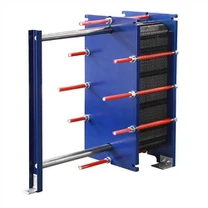
Plate heat exchanger
High heat transfer efficiency, compact structure, operational flexibility, low metal consumption, small heat loss and easy to install and dismantle the advantages of the rapid development and increasingly wide range of applications.
Since the plate heat exchanger into industrial applications, the selection of sealing liner materials is one of the main issues affecting the use of plate heat exchangers, especially the liner material temperature resistance is the most prominent impact. But its weakest link also lies in the gasket.
For plate heat exchanger, usually use elastic seals, such as nitrile rubber (NBR) or ethylene propylene diene rubber (EPDM). Heat exchanger seals also suffer from ageing, which leads to a gradual degradation of their performance and eventual loss of usefulness. The elastic properties are gradually eroded by thermal and chemical causes, which, together with various other factors, accelerate the ageing process of the seal.
Usually affect the service life of the sealing gasket factors can be summarised as follows four points:
1. The influence of plate heat exchanger size
Plate heat exchanger is composed of a fixed cover, a movable cover and a set of plates. The structural principle is that the group of plates is pressed between the front and rear end plates with the help of a screw, which also generates the necessary pressure on the sealing ring. Based on this structure of the heat exchanger, during the heat exchanger pressing process, the movable cover plate is constantly pressed closer to the fixed cover plate, resulting in the plates near the movable cover plate being the first to be pressed. The more plates to be pressed, the greater the pre-stress generated. Because of this structural characteristics, in the same working conditions, the number of plates will also affect the service life of the heat exchanger seal.
2. Plate heat exchanger is located in the impact of the position
The use of plate heat exchanger seals are not only affected by light, climate, but also by the surrounding environment. So placed in the outdoor heat exchanger
Heat exchanger placed in the outdoor compared to the indoor, the service life of the seal will be different. In order to minimise the effects of the environment, it is very effective to use a protective cover or an insulating layer on the outside of the plate heat exchanger.
3. Influence of the operating conditions of the plate heat exchanger
The influence of temperature and pressure changes on the service life of seals should not be underestimated. The stress peaks generated in the various parts of the seal under changing conditions are more fatal to the internal organisation of the material than constant loads over a long period of time. Similarly, start-stop procedures or long downtimes can have a negative impact on seal life. From a plant point of view, if the process requires frequent start-ups and shutdowns, spring loaded devices between the tie rods and the removable cover plate are used to minimise the effect of temperature load variations on the seals.
3. Influence of plate heat exchanger conditions
Temperature and pressure changes on the service life of the seal can not be underestimated. In the case of a change in operating conditions, the stress peaks generated in the various parts of the seal are more fatal to the internal organisation of the material than a constant load over a long period of time. Similarly, start-stop procedures or long downtimes can have a negative impact on seal life. From the machine's point of view, if the process requires frequent switching on and off, a spring-loaded device between the tie rod and the removable cover reduces the effect of temperature load variations on the seal.
4. Influence of the medium flowing in the plate heat exchanger
The medium flowing through the plate heat exchanger has the greatest influence on the life of the seals. For how to choose the right seal, in the fluid substances and conditions of use are often not perfect, in the design process is often ignored in the cooling, heating additives, inhibitors and other substances in the mix, and these substances to penetrate into the seal resulting in the destruction of its physical properties.