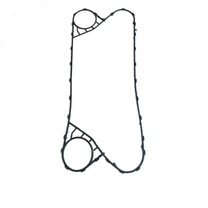
1 Analysis of the causes of seal failure and related preventive measures
The main reasons for seal failure are pressure, temperature, time and operating conditions.
1.1 Pressure
Plate heat exchanger type has removable, sealed, such as plate removable heat exchanger in the rated working pressure, leakage, in addition to the equipment in the manufacturing quality, mainly with the system has an abnormal impact load, which is not easy for the operator to find the phenomenon. Shock caused by an instantaneous pressure increase, the pressure may be higher than the normal pressure 1 to 3 times, so that the installation of the plate heat exchanger in the sealing gasket displacement, resulting in seal failure. And because of the equipment of the heat transfer element is manufactured by the sheet one-time forming, the thickness of 0.5 ~ 0.8mm, sealing the rigidity, bearing relatively poor, and there are heat exchanger plate periphery longer, impact resistance is relatively bad, compared to other heat exchangers such as tubular to be much worse.
In this regard, appropriate precautions should be taken: depending on the operating pressure, increase the design pressure of the equipment for the use of pressure 1.5 ~ 2 times; use should try to avoid the impact phenomenon in the system; special circumstances to take measures to increase the thickness of the plate.
1.2 Temperature
Rapid changes in temperature also cause seal failure. When the temperature changes too quickly, the expansion coefficient of the gasket does not match the elastic deformation and the preload of the seal, so that the preload of the seal decreases, resulting in the ability of the equipment to withstand less than the rated working pressure.
This should take the following measures to solve: in the operation of the equipment should be as slow as possible to raise the pressure and temperature; in the clamping bolt designed to compress the preload spring to compensate for changes in preload force.
1.3 Time
Plate heat exchanger use time problem, with the growth of the use of time, the sealing gasket material will also be aging. Resulting in the sealing use effect, affecting the sealing effect of the plate heat exchanger.
In this regard, according to the characteristics of the material, select the appropriate material sealing washer, and according to the use of different situations, the use of different sealing washers.
1.4 Operating conditions
The different conditions of the process medium can also cause seal failure. Such as the temperature of the oversaturated steam for a short period of time will cause seal failure. And the same temperature saturated steam can form a water film on the surface of the gasket, the gasket can play a protective role.
Choosing the right process medium for the operating conditions is also a way to ensure that plate heat exchangers are protected against failure.
2 Analysis of Plugging and Scaling Failure Causes and Corresponding Preventive Measures
2.1 Plugging
Plate heat exchanger circulation gap is small, about 2.5 ~ 6mm, the diameter of more than 1.5 ~ 3mm particles of debris easily block the channel, so that the pressure drop in the equipment changes dramatically, the circulation is reduced, the heat transfer effect is reduced, and it is easy to make the equipment failure. Preventive measures can be set in the media inlet filter or flushing device, regular cleaning or treatment.
2.2 Scaling
Plate heat exchanger after use, due to the heat transfer or cooling of the medium, resulting in scaling, scaling can lead to plate heat exchanger heat transfer coefficient is reduced, and in severe cases will also block the plate channel. Plate heat exchanger designed with a large number of support contacts, designed to support the flow of media pressure support role, the side effect of which is to make the fluid formed a local stagnant flow and the formation of fouling, with time and at the appropriate temperature, the cooling water calcium and magnesium ions precipitation, and increasing, the formation of honeycomb scaling.
Clogging and scaling in the cause is different, but the impact is the same. Countermeasures to prevent is: plate heat exchanger should not be used in dirty or easy to scale materials; do not use unsoftened water as a cooling medium, and the temperature should be relevant requirements, to avoid calcium and magnesium ions precipitation of sensitive temperature zone. And when the new system is put into operation, the heat exchanger should be separated from the system for a period of time cycle, and then put the heat exchanger into the system.
3 Corrosion failure cause analysis and preventive measures
Plate heat exchanger corrosion failure types of pitting, crevice corrosion, stress corrosion cracking, uniform corrosion and other corrosion failure, corrosion is a complex chemical phenomenon, such as rust on the surface of the plate or the accumulation of scale pitting; in the sealing of the gasket groove bottom or the plate closed to produce the crevice corrosion; all or most of the metal surface in contact with the medium is corroded uniform corrosion.
This should take the following effective preventive measures: the correct choice of plate materials; regular cleaning of dirt, in order to destroy the conditions and development of corrosion generation; selection of non-chlorine-containing elements of the binder.
4 design, manufacture and installation of the reasons for analysis and measures
Due to the characteristics of plate heat exchanger high efficiency and energy saving, widely used in many fields, dealing with a variety of media, in the use of the production process, even more conditions are different and diverse. The choice of gaskets is critical, if the choice is not appropriate, the material does not meet the physical properties of the process media, elasticity is not good, in use, there is a de-padding, elongation, deformation, aging, fracture and so on.
Plate in the manufacturing process, stamping in the residual stress, used in corrosive environments, will produce stress corrosion, direct damage to the plate.
The surface of the plate is not flat, the equipment in the installation and use, maintenance, it is not easy to install the centre, making the compression force is not uniform, affecting the seal, resulting in leakage.
In this regard, in the installation should try to install the centre, so that the compression force is uniform, so as to maintain the compression in use, not leakage.