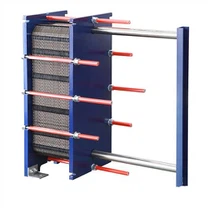
Plate heat exchanger process form
Process combination form should be based on heat transfer and fluid resistance calculations, in order to meet the process conditions required to determine. Try to make the convective heat transfer coefficient in the cold and hot water flow path is equal or close, so as to get the best heat transfer effect.
Because in the heat transfer surface on both sides of the convective heat transfer coefficient is equal or close to the heat transfer coefficient to obtain a larger value. Although the plate heat exchanger plate flow rate is not equal, but in the heat transfer and fluid resistance calculation, but still to the average flow rate calculation. Because of the "U"-shaped single-flow receiver are fixed in the compression plate, easy to disassemble.
According to the media flow and temperature difference, can be divided into a single process, double process, three process and multi-process form of heat exchanger.
1, single-flow plate heat exchanger is the medium in the heat exchanger flows through a process.
2, double-flow plate heat exchanger refers to the medium in the heat exchanger folded back through two processes.
3, with multi-process plate heat exchanger, the four interfaces of the heat exchanger can not be on the same side of the clamping plate, the import and export to be located in the front and rear of the two clamping plate.
Plate heat exchanger process selection methods and standards
1, in general, in the selection process, as far as possible, using a single process ( full parallel ), so that the equipment in use when dismantling and maintenance are more convenient. If you want to use more processes, the process is usually arranged in the same number of flow paths. 2, for the symmetry of the plate, hot and cold media flow rate is equivalent, it is appropriate to use the same arrangement, so that the media flow for the full countercurrent, to obtain the maximum average temperature difference.
3, when the flow rate between the plate must be, the number of runners depends on the size of the flow.
4, when the two sides are not equal, countercurrent and downstream will alternate.
5, when the difference between the two sides of the flow rate is large, the flow rate of the small side should be used in a multi-route arrangement, in order to improve the flow rate, enhance the effect of heat transfer.
6, the determination of the number of flow channel by the influence of the flow rate between the plate, and the selection of the flow rate between the plate has a certain range, but also by the allowable pressure drop constraints.
Picture