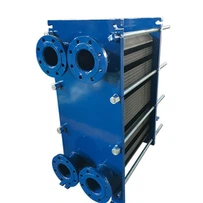
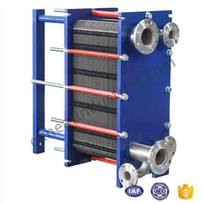
| Product characteristics of GPHE | |
| Item | Plate Heat Exchanger for HAVC |
| Brand | Exheat |
| Plate material | Stainless steel 0.5mm 0.6mm 0.7mm 0.8mm 1mm |
| Gasket material | NBR HNBR EPDM HEPDM VITON FKM Silicone(FDA Standard) |
| Frame material | Stainless steel |
| Color of frame | Blue or Customed color |
| Connection type | Flange or Thread |
| MOQ | 1 set |
| Package | Polywood case |
| Warranty | One year |

About HVAC Systems
HVAC stands for Heating, Ventilation and Air Conditioning and is widely used in commercial buildings, residential buildings and other facilities to provide heating, cooling, ventilation and indoor climate control.
HVAC systems continue to place greater emphasis on energy efficiency, heat recovery and effective thermal management. Plate heat exchangers are commonly used in these systems because they provide efficient heat transfer in a compact configuration and can be adapted to different heating and cooling requirements.
About PHEs applied in HVAC systems commonly
1. Heat Recovery
Plate heat exchangers can be used in HVAC heat recovery systems to transfer heat from one fluid circuit to another. By recovering available heat and transferring it to another part of the system, the HVAC system can reduce the amount of energy required for heating or cooling.
2. Water-to-Water Heat Transfer
Plate heat exchangers can transfer heat between two separate water streams, such as heating water and chilled water. This allows heat to be transferred efficiently between different circuits while keeping the fluids separated.
In HVAC systems, this configuration can be used for heating and cooling applications and can help reduce the operating load of other HVAC equipment.
3. Domestic Hot Water
Plate heat exchangers can also be used to heat domestic hot water. In this application, hot water from a primary heating source passes through one side of the heat exchanger and transfers heat to the domestic hot water circuit.
This configuration can be used for applications such as showers, washing machines, dishwashers and other domestic hot water requirements.
4. District Heating
Plate heat exchangers are commonly used in district heating systems to transfer heat between a district heating loop and a building's heating system.
The heat exchanger separates the two circuits while transferring heat from the central heating source to the building's heating system. This allows buildings to receive heat from a central source instead of relying on individual boilers.
Why Use a Plate Heat Exchanger in HVAC Systems?
Plate heat exchangers are widely used in HVAC systems because of their:
- Efficient heat transfer – Provides effective heat transfer between separate fluid circuits.
- Compact design – Requires relatively little installation space.
- Flexible configuration – Can be configured for different heating, cooling and heat recovery requirements.
- Wide range of applications – Suitable for water-to-water heat transfer, domestic hot water, district heating and heat recovery applications.
HVAC Plate Heat Exchanger Selection
The correct plate heat exchanger configuration depends on the actual HVAC operating conditions. The main information required for selection includes:
- Heating or cooling capacity
- Inlet and outlet temperatures
- Flow rate
- Heating or cooling medium
- Operating pressure
- Allowable pressure drop
- Required heat transfer duty
Providing these parameters allows the required heat transfer area and suitable plate heat exchanger configuration to be evaluated.
FAQ
Hot Tags: heat plate exchanger boiler, China, suppliers, manufacturers, cheap, pricelist, low price, for sale, plate heat exchanger kaori, 28i junior plate heat exchanger, 75 kw plate heat exchanger, 24i junior plate heat exchanger, plate heat exchanger lab report, plate heat exchanger korea