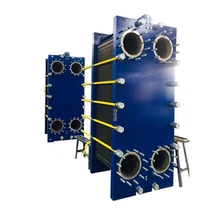
Plate heat exchanger circulation cross-sectional area is small, such as not timely maintenance, maintenance, there is a risk of blockage caused by scaling, affecting the safety of equipment and normal use. Correct installation and maintenance is an important part of ensuring the safety and efficiency of the heating system. Due to the number of plate heat exchanger plate, and to clean up piece by piece, all replaced with new pads, so the overhaul is generally used as a whole to lift off the installation location, in a suitable location to disassemble the overhaul. Before dismantling, the media import valve will be closed, and should first close the high pressure side of the valve, and then close the export valve, so that the heat exchanger slowly cool down to 40 ℃ after the discharge, and then remove the connected pipeline, the overall lifting can be carried out.
Plate heat exchanger maintenance cycle is generally 2 years. Before the overhaul, the gaskets to be replaced need to be carefully checked for smooth surfaces, consistent thickness, no transverse cracks, no bubbles, no gaps, no ageing, no laps and no traces of butt joints. The bonding agent used should also be within the expiry date. For the heat exchanger body, take down the compression bolt protection sleeve and de-rust and oil all the bolts; check the sliding surface of the upper beam and wipe it clean; check the upper rollers of the movable pressure plate to make it flexible; measure and record the length of the plate stack "A" and ensure that this dimension remains unchanged when reassembling.
Wait until the system gas, pressure, temperature and other parameters meet the maintenance requirements before entering the site. Remove the receiver first, then loosen the fixing bolts in a diagonal direction. During the dismantling process, the movable pressure plate should be shifted by no more than 10mm in the width direction and no more than 25mm in the vertical direction, and should always be kept in a parallel state of movement. Remove the plate, so that the plate to the side of the tilt 15 ° -20 °, up a little lift can be removed, shall not be forced to remove, to prevent the upper positioning groove deformation or damage, and then according to the block installation order in order to code.
Check the heat exchanger plate, the plate should be free of cracks, scratches, deformation and other defects, plate thickness uneven deviation shall not exceed 5%, the perimeter of the plate should be smooth and flat, the shape of the sealing groove should be in accordance with the requirements of the drawings, the depth of the allowable deviation of 0.1mm, the sealing surface is not allowed to have a bump, crease, distortion, scratches and other defects affecting the sealing performance, the depth of the plate corrugation allowable deviation ± 0.2mm, the unevenness shall not The unevenness should not be greater than 1%. For perforated plates, hydrogen arc welding can be used to repair and flatten them. For serious deformations, aluminium or copper models can be used for correction. If these defects cannot be dealt with, the plates can only be renewed or reduced.
First remove the old gasket. Heat an electric hot air in one hand along the bottom of the sealing groove and, when the adhesive has softened with the heat, pull the pad up with the other hand and peel it off slowly. A gas torch can also be used for heating, but the flame should be strictly controlled to a distance of 10-15cm to the bottom of the sheet, more so for aluminium alloy sheets. Heating with an acetylene flame is prohibited under any circumstances. After removal of the gasket, the residual glue in the sealing groove can be removed by using a 40-50 mm diameter, 8-10 mm wide stainless steel wire wheel mounted on a tangential grinder to grind away the residual glue and ensure a clean sealing groove.
Before assembling the plate, push the movable pressure plate to one end, clean the inside of the fixed pressure plate and movable pressure plate and the pipe mouth, and firstly add the pipe mouth rubber sleeve and rubber sleeve support ring. When installing the plate, according to the process combination, the first piece without the rubber pad will face the fixed pressure plate, and then all the plates will be hung in order according to the order of A-B-A-B. After all the plates have been hung, the movable pressure plate is pushed together and the 6 long bolts are fitted and tightened. During this process, the movable platen should be kept moving in parallel. When the bolts are tightened, the deviation of the length of the plate stack "A" measured at the adjacent bolts shall not exceed the following standard: when A<1000mm, not more than 1mm; when A>1000mm, not more than 2mm, and the deviation of the length of the plate stack between the bolts shall not be greater than 0.5%A.