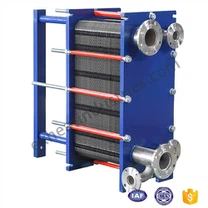
Plate heat exchanger is one of the indispensable equipment in the industrial field, and shallow corrugated plate heat exchanger is one of the types. You may already know something about plate heat exchangers, but do you know what are the advantages and disadvantages of shallow corrugated plate heat exchangers compared to deep corrugated plate heat exchangers? This article will introduce you.
Shallow corrugated plate heat exchangers (Shallow corrugated plate heat exchangers) and Deep corrugated plate heat exchangers (Deep corrugated plate heat exchangers) are two different designs of plate heat exchangers (Plate heat exchangers, PHE). They differ in heat transfer efficiency, pressure drop, cleanliness and suitability. The following are some of the advantages and disadvantages of shallow corrugated plate heat exchangers compared to deep corrugated plate heat exchangers:
Advantages and disadvantages of shallow corrugated plate heat exchanger:
Advantages of shallow corrugated plate heat exchanger:
1. High heat transfer coefficient: Shallow corrugated plate heat exchangers usually have a higher heat transfer coefficient, which means that they can transfer heat more efficiently under the same flow conditions.
2. Lower pressure drop: Due to the wider flow channels, there is less resistance to fluid flow in shallow corrugated plate heat exchangers, which results in a lower pressure drop.
3. Ease of cleaning: Shallow corrugated plate heat exchangers have widely spaced plates, which makes them easier to clean and maintain, reducing the possibility of fouling and scaling.
Disadvantages of shallow corrugated plate heat exchangers:
Takes up more space: due to the shallow corrugation of the plates, in order to achieve the same heat transfer area, a shallow corrugated plate heat exchanger may require more plates, thus taking up more space.
2. Not suitable for high viscosity fluids: Shallow corrugated plate heat exchangers do not handle high viscosity fluids as well as deep corrugated plate heat exchangers because deep corrugation provides better flow mixing and heat transfer.
Advantages and disadvantages of deep corrugated plate heat exchangers:
Advantages ofdeep corrugated plate heat exchangers:
1. for high viscosity fluids: deep corrugated plate heat exchangers are better able to handle high viscosity fluids because their flow channel design helps to enhance fluid turbulence and mixing.
2. Compact: Deep corrugated plate heat exchangers can accommodate more heat transfer area in a smaller space, so they are more advantageous in space-constrained applications.
3. High heat transfer efficiency: Deep corrugated plate heat exchangers can produce stronger fluid disturbances due to their special corrugated design, thus improving heat transfer efficiency.
Disadvantages of deep corrugated plate heat exchanger:
1. large pressure drop: deep corrugated plate heat exchanger flow channel is narrower, the fluid flow resistance is larger, resulting in a higher pressure drop.
2. Difficulty in cleaning: Deep corrugated plate heat exchanger has smaller plate spacing, which makes cleaning and maintenance relatively difficult, and easy to accumulate dirt.
When choosing shallow corrugated plate heat exchanger or deep corrugated plate heat exchanger, it is necessary to consider according to the specific application needs, the nature of the fluid and the requirements of the system design.