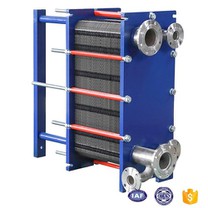
Due to the plate heat exchanger's extremely high heat transfer efficiency and cost-effective, it is now widely used in various industries, and is a very common heat exchanger. High heat transfer coefficient, logarithmic average temperature difference, small footprint, lightweight, low price, small temperature difference at the end, low fouling coefficient, easy to clean, easy to change the heat transfer area and process combinations, etc., these are the advantages of the plate heat exchanger. So in the production work plate heat exchanger failure, how should we solve it? What are the common troubleshooting methods? Let's explore it.
First, the common failure of plate heat exchanger
1. Media leakage
Form I: leakage, leakage when the amount of media is not large, and discontinuous;
Form two: leakage, leakage of a larger amount of media, and media continuous.
Leakage occurs mainly in the seal between the plate, plate end and compression plate inside and plate corrugated groove parts.
2. Media inlet and outlet pressure difference is large
The media outlet pressure is too small, the pressure drops beyond the design requirements, directly affecting the system's heat transfer effect, and can not meet the system's flow and temperature. Can not play the role of heating (or cooling) medium.
3. Media mixing
Manifested as a higher pressure side of the medium mixed into the lower pressure side of the medium, there will be abnormal temperature and pressure. If the medium is corrosive, but also causes corrosion of other equipment in the system. Usually occurs in the secondary sealing area or inflow area. The cooling effect is not obvious. The main feature is that the outlet temperature of the cooled medium is high, and not up to the design requirements.
Second, the plate heat exchanger's common troubleshooting methods
Add regenerative cooling system
The so-called regenerative cooling system is the same fluid in the plate heat exchanger between the import and export pipeline additional piping and valves, and then through the valve adjustment to change the direction of flow of the two fluids, so that the backwash to eliminate the accumulation of impurities on the plate. Before the transformation of the normal process is also the transformation of the circulating water side of the closing of the additional valves when the normal process, after the transformation of the backwash process, is also the transformation of the circulating water side of the original import and export valves, open the additional valves when the backwash process. Through the flow of circulating water and lubricating oil through the plate heat exchanger of the two heat transfer fluid pipeline modifications, on the heat exchanger itself, the normal process and backwash process two working conditions have no difference, so the plate heat exchanger in the normal operation of the process to greatly reduce the impurities on the plate between the blockage of the channel.
Additional filters on the circulating waterside
In the plate heat exchanger circulating water inlet pipeline add a fine filter equipped with a secondary filter and the corresponding sub-line, and regularly use the sub-line operation, remove the filter on the fine filter for cleaning, effectively preventing the packing debris and other impurities into the heat exchanger.
Disintegration maintenance
Plate heat exchanger disintegration plate heat exchanger can be arranged by the maintenance situation and the time required for on-site disintegration maintenance or the whole dismantled and hoisted to the appropriate location before disintegration maintenance. Before disassembling, first use a tape measure to carefully measure the distance between the two compression plates B value, to keep a spare, and then use a wrench to clamp the nut by the order of diagonal cross grouped uniformly loose, and then remove the clamping screw, and then the activity of the compression plate to the end of the column, and then the plate to support the plate to the plate to move to the top of the notch of the guide bar, the front or the back of the tilt out of the plate.
Cleaning and protection of the plate
Keeping the plate piece clean is one of the important conditions for maintaining the high heat transfer coefficient of the plate heat exchanger. Between the plates, the medium is along the narrow zigzag channel movement, even if the production of a not too thick layer of scale, will cause large changes in the flow path, significantly affecting the movement of the fluid, so that the pressure drop increases, the heat transfer coefficient decreases. For general dirt, the use of a chemical cleaning method or mechanical (physical) cleaning method can be, and for hard thick dirt layer, it is necessary to take the first chemical cleaning method to soften the scale layer, and then mechanical (physical) cleaning method to remove the scale layer of the integrated cleaning method cleaning to ensure that the plate surface clean and clean.
According to the used plate heat exchanger circulating water side of the dirt characteristics, the following methods:
a. Cleaning of foreign impurities and deposits: mechanical (physical) cleaning method, with soft brushes and water for manual scrubbing.
b. Hard thick layer of cleaning scale: according to the specifications of the plate to make an internal space of 1200 × 350 × 500mm sink, will be dismantled into the slot, at room temperature with 5% of the nitric acid solution soak 8h or so, fish out with a soft brush and clean water can be cleaned. Of course, the scaling is not a very serious plate, or due to maintenance time constraints can not be used as a comprehensive cleaning method cleaning, with a stainless steel wire brush or stainless steel cleaning ball, and water scrubbing, can also clean the plate.
Plate sealing groove cleaning
Plate heat exchanger sealing gasket is a key part, of most of China's adhesive gasket paste in the plate gasket groove "paste type" sealing structure. BR02 type plate heat exchanger sealing gasket and the plate between the adhesive for bonding plastics and rubber 401 instantaneous dry adhesive, it is with the stainless steel plate combination strength of moderate. Moderate. Replacement of the gasket, the plate sheet flat on a flat plate, with a screwdriver to cock the gasket, gently tear off. For the residual rubber in the gasket groove, use a stainless steel wire brush or stainless steel cleaning ball with acetone carefully and gently brush, and then rinse with water.
Inspection of the plate
Cleaned plate should be strictly macro-inspection of each piece, if necessary, and then translucent, coloring or penetration test, any plate shall not have the following defects:
a. The surface is not allowed to have pits, scratches, indentations, burrs, etc. that exceed the thickness tolerance;
b. The depth of corrugation and gasket groove depth deviation should be no more than ± 0.1mm;
c. Neither the plate heat exchanger part nor the sealing groove shall have corrosion perforations or cracks, if the plate heat exchanger part has perforations or cracks, it can be repaired by argon arc welding with careful welding and grinding.
Summarize
Plate heat exchanger common failure of media leakage, media inlet, and outlet pressure difference, media mixing, and cooling effect is not obvious in four forms. Correct overhaul, and construction process can effectively prevent heat exchanger failure, to ensure the safe and reliable operation of the heat exchanger. Expanding the heat transfer area of the heat exchanger, increasing the heat transfer temperature difference, improve the heat transfer coefficient can strengthen the heat transfer effect of heat transfer equipment.