Whether it is light industry or heavy industry, or chemical industry, plate heat exchanger plays a very important role in it. Today I came to answer why chemical heat exchanger can be used plate heat exchanger working conditions most choose it, rather than choose the column tube heat exchanger?
Plate heat exchanger has a heat transfer (heating, preheating, cooling, condensing) role, as long as the liquid - steam, liquid - liquid heat exchange between the plate heat exchanger can be used.
Plate coolers
In this to "energy saving" cliché period, but also a major strategic issue in the new period, and plate heat exchanger in which the role played by any of the relevant enterprises can not be ignored, because they are related to the cost of profit issues, so each want to save energy and reduce consumption of enterprises must be taken seriously.
Many users are concerned about imported heat exchangers, they do not realize that the domestic heat exchanger has been updated for several generations. And whether it is pre-sales, sales, after-sales are doing a very good job.
In most pharmaceutical companies, there are generally two types of water-water heat exchangers used: one is a tubular heat exchanger and the other is a plate heat exchanger. So why do I recommend plate heat exchangers? In addition to the comparison of the differences between the two in previous articles, I would like to highlight the following points:
1, heat transfer coefficient:
(1) column tube heat exchanger is a fluid laterally swept through the tube wall and the tube flow of another fluid heat exchange, vertical cross-flow with each other, its heat transfer coefficient is generally 1000-3000w / (m.℃).
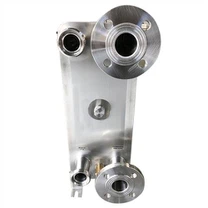
Stainless steel plate heat exchanger
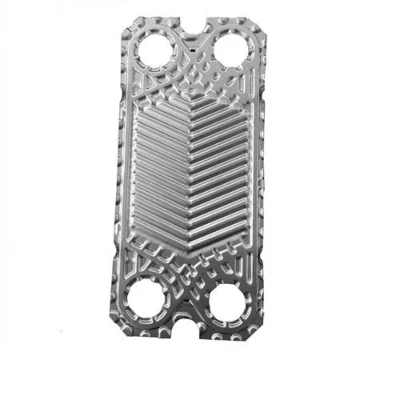
(2) plate heat exchanger in the cooling water side and the side of the cooled water flow uniform turbulence. The two fluids flow in the opposite direction, due to the role of the corrugation caused by turbulent flow. This results in a high heat transfer rate, a high resistance pressure drop and a high shear stress field, which will result in preventing fouling from forming on the heat transfer surface. The heat transfer coefficient is typically 4000-7000 w/(m.°C). As a result, the heat transfer area of the heat exchanger can be saved.
2, end difference:
(1) tubular heat exchanger heat transfer end difference that the cooling water inlet temperature and the temperature difference between the cooled water outlet is about 5 ℃;
(2) plate heat exchanger due to its structural characteristics can be economically achieved as low as 1 ℃ end difference.
3, cooling water:
(1) tube heat exchanger general cooling water and the ratio of the water being cooled to 1.2:1;
(2) plate heat exchanger due to the two media flow channel is basically the same and high heat transfer efficiency, so the plate heat exchanger can greatly reduce the cooling water, the general cooling water and the cooling water ratio of 0.8-1.11, which can reduce the installation and operation costs of pipeline valves and pumps.
Of course, the plate heat exchanger also has its shortcomings, is suitable for low-pressure conditions, more than its pressure-bearing capacity can only choose the tube type heat exchanger.