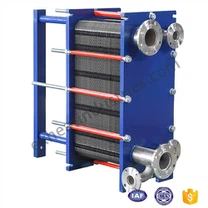
With its light weight, small footprint, Low investment, high heat transfer efficiency, assembly flexibility, easy to remove scaling, etc., and its role in heating and its role in heat supply work. Increasingly by the heat supply enterprises attach great importance to And gradually promote the use of To replace the original shell and tube heat exchanger. But due to the plate heat exchanger circulation cross-section is small, the Fouling is prone to clogging, the So that the plate heat exchanger heat transfer efficiency is reduced. Affect the safety of the equipment and the user's normal heat. Therefore Solve the cleaning of plate heat exchanger Prevent the formation of scale Will become an important issue to ensure safe production and economic operation.
Plate heat exchanger blockage
Plate heat exchanger in use. Plate heat exchanger flow channel clearance is small (2.5 ~ 6mm), the Diameter greater than 1.5 ~ 3mm particles and debris easily block the plate channel, so that the equipment pressure drop deteriorates sharply, and the pressure drop of the device. So that the pressure drop of the equipment deteriorates sharply, and the equipment is blocked. The pressure drop of the equipment deteriorates sharply, resulting in a significant reduction in the heat transfer capacity of the equipment due to clogging. Due to improper operation of water treatment equipment Water quality control is not up to standard. Unqualified softened water injected into the heating system. Calcium, magnesium, carbonate in the water after heat Decomposition of calcium carbonate and magnesium hydroxide precipitates Bonded in the heat exchanger on the heating surface, the Formed a hard scale. Because of the poor thermal conductivity of the scale, the heat exchanger heat transfer efficiency is reduced and the serious waste of heat energy. This affects the effect of heating to the heat supply unit has caused serious negative impacts.
Plate heat exchanger scaling
Fouling can cause a reduction in the heat transfer coefficient of the heat transfer equipment. In severe cases, it can also block the plate channels. Plate heat exchanger plate design has a large number of support points, the Designed to play a perturbation of the medium (so that the medium turbulence to improve the heat transfer coefficient) and pressure support role, the Is easy to collect solid debris place, the Its side effect is to make the fluid formed a local stagnation and generate dirt cumulus, the Calcium and magnesium ions in the medium After precipitation at the appropriate temperature It is easy to adhere to the growth on the cumulus, the Formation of honeycomb scale. Clogging and fouling in the cause although different, but the impact on the plate heat exchanger. But the plate heat exchanger on the impact of the results are the same.
Use of plate heat exchangers The following points should be noted:
(1) Plate heat exchanger
Should not be used in dirty or easy to scale the environment (unless additional effective other measures).
(2) The use of unsoftened cooling water as a cooling medium, the
Operating temperature should be controlled at about 50 ℃ or lower.
To avoid the sensitive temperature of calcium and magnesium ion precipitation in the medium.
Whether it is clogging or scaling, the
Plate heat exchanger according to the use of different situations
Take periodic chemical cleaning or dismantling is also very effective.
Several measures to prevent plate heat exchanger scaling:
1) strictly control the water quality in operation.
The water in the system and the softened water in the softening tank must be
Strict water quality testing.
Qualified to be injected into the network.
2) when the new system is put into operation.
Heat exchanger should be separated from the heating system.
After a period of circulation, the
And then the heat exchanger and people in the system.
To avoid impurities in the network into the heat exchanger.
3) In the heating system.
In addition to the dirt separator and filter should be cleaned from time to time.
Should also keep the pipe network clean
to prevent clogging of the heat exchanger.