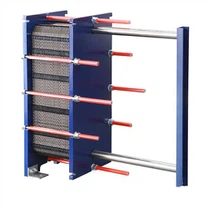
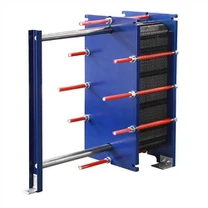
Plate heat exchangers are also called plate heat exchangers. In addition to maintenance under special circumstances, regular maintenance should also be carried out. Because the plate heat exchanger is easy to disassemble and assemble, and the maintenance is simple, special tools and equipment are generally not needed. Different methods can be used according to different situations. If the equipment does not leak, but the heat transfer system K has dropped, you can use a closed circuit system to pump the descaling liquid into the equipment and circulate for several hours without disassembling the heat exchanger. That's it. There is no such condition on site, and when the equipment is disassembled or the scale is found to be not too serious, you can wash it directly with water without removing the plate, while scrubbing with a soft brush. Let's take a closer look at the maintenance steps!
1. Parking
When shutting down for maintenance, first slowly close the fluid valves on both sides of the heat exchanger, so that the pressure on both sides drops slowly at the same time, and then loosen the tightening nut after emptying the residual liquid. When disassembling the tie rod, the temperature must be lowered to room temperature and the remaining liquid must be emptied as much as possible before proceeding.
2. plate cleaning
A clean and oxide-free surface of the plate is a necessary condition to ensure tightness. When the thermal efficiency of the plate heat exchanger is significantly reduced, and the pressure drop is significantly changed, the scaling is serious, and the plates should be disassembled and cleaned. Using steam bubble tank and chemical cleaning method is an effective method to obtain high-quality surface quality. When cleaning, first put the plate in a lye tank with a temperature of 57-60°C (if the temperature is 70-80°C) for 48h, and use the high temperature of the lye to make the sealant glued on the plate and fouling soften. Then, soak the plate in the acid bath for 2 hours to fully react the scale with the acid. After the plate is soaked, clean it with a soft brush on the platform, and it is forbidden to use steel brushes.
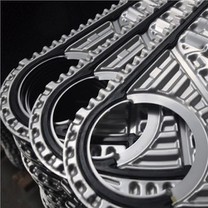
When cleaning the sealing groove, lift the washer with a screwdriver, gently remove it (or lightly bake it with fire on the back, but avoid discoloration of the metal), and then tear it off. Use acetone methyl liquid or other ketone organic solvents to clean the sealed tank.
Rinse the cleaned plates with clean water first, and then dry them with a clean cloth. No foreign particles or fibers are allowed on the plate. The chloride ion content of the cleaning water is less than or equal to 25pp.
3. Check and confirm the workload. After cleaning, check the plates carefully. There are three inspection methods:
1. Coloring method: check with coloring agent;
2. Light transmission method: a light source is placed on one side of the plate, and people check on the other side;
3. One-sided pressure test method: One-sided water test pressure to 0.35MPa (gauge pressure), if there is water at the lowest point on the other side, quickly check the wetness of the plate. We choose the light transmission method for inspection, which has the advantages of convenience and low cost, and is suitable for inspection of new and old plates. But the sense of responsibility of maintenance personnel is high.
According to the inspection situation of the board, determine the workload, there are three main types:
1. Replace all plates and gaskets;
2. Only replace the gasket;
3. Replace gaskets and partially damaged or severely deformed plates.
Fourth, the gasket paste
Use adhesive or strong adhesive to apply a layer evenly on the bottom of the sealing groove, and then put the gasket in the sealing groove, stick it evenly, pressurize, dry naturally, or heat to 100℃-120℃ for two hours Let dry afterwards. Check one by one to see if the fit is even, and remove the excess adhesive.
Fifth, assembly
The characteristic of the plate heat exchanger process combination is: if the fluid enters from the hole on the left corner of the plate, it always exits from the hole on the left corner of the plate, and vice versa. When assembling, it is necessary to distinguish A board and B board correctly, that is: take the side of the sheet adhesive pad as the front, distinguish according to the direction of the diversion groove, and set the plate with the diversion groove in a certain direction as the A plate, then the guide The plate with the runner in the other direction is the B plate, but there is no mark on the plate.
Sixth, hydraulic test
Four blind plates are made according to the size of the connecting pipe flange, and they are welded at the entrance and exit, and pipes are welded on the plates to connect the compressor and the heat exchanger. Install a pressure gauge that has passed the verification and is within the validity period at the inlet and outlet. The range of the pressure gauge should be twice the test pressure. The test pressure is 1.5 times the working pressure.
1. Carry out inspections and repairs strictly according to the above requirements, the quality fully meets the design requirements, and there is no leakage during the 72-hour load test. The temperature measurement results of the heat exchange liquid: the alumina mother liquor inlet is 45.2°C, the outlet is 84.6°C; the alumina semen inlet is 97.0°C, and the outlet is 78°C, which meets the requirements of normal operation.
2. Cost saving. Since the plate material is ultra-thin Crl7Nil3Mo2Ti stainless steel, and the gasket is also special, it is very expensive to replace all the new plates. After cleaning, checking and reusing, a single plate heat exchanger can save 250,000 to 450,000 yuan in cost.