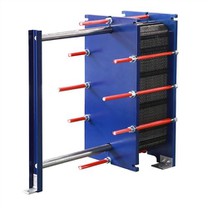
Plate heat exchangers are widely used in industries such as food processing, machinery manufacturing, metallurgy, petrochemicals, and marine engineering due to their high heat transfer efficiency, low pressure drop, compact structure, lightweight design, and small installation footprint. Their flexible plate configurations, interchangeable components, wide material options, and suitability for mass production make them one of the most commonly used heat exchange solutions.
Because the reliable operation of a plate heat exchanger directly affects production efficiency and process safety, a thorough inspection after repair is essential. A standardized acceptance procedure helps verify repair quality and ensures the equipment can return to safe and stable operation.
This article explains the key acceptance standards and inspection procedures for plate heat exchangers after repair.

1. Cold Testing-One of the Most Important Acceptance Procedures
Cold testing is one of the most critical steps in the acceptance process following a major overhaul of a plate heat exchanger. Its purpose is to evaluate the overall performance of the repaired equipment under low-temperature operating conditions and identify any potential problems before the unit is returned to service.
The test should always be carried out in accordance with the equipment manufacturer's technical documentation or an approved cold testing procedure. The inspection process should never be simplified or performed below the required standards.
During the cold test, inspectors should focus on two key aspects.
First, carefully examine the heat exchanger, connected piping, and valves for any deformation caused by low temperatures. Since many plate heat exchangers operate under cold-service conditions, repaired components must maintain their structural integrity during thermal contraction. Excessive deformation can reduce sealing performance and shorten equipment service life.
Second, inspect the equipment for signs of leakage by observing frost formation on external surfaces. During low-temperature testing, leaking process media often produce visible frost around the leak point. Any suspected leakage should be clearly marked so corrective repairs can be carried out before the equipment is accepted.
The cold test is considered successful only when all components remain within the allowable deformation limits, compensation systems function properly, and no leakage is detected.
2. Comprehensive Inspection and Load Testing
After the cold test has been successfully completed, a comprehensive inspection should be performed, followed by load testing to further verify the repair quality and operating performance of the plate heat exchanger.
2.1 General Inspection
The first step is to confirm that all repair work has been completed according to the approved maintenance plan and meets the applicable technical standards.
The maintenance contractor should provide complete documentation, including:
- Fault diagnosis reports
- Repair procedures
- Replacement parts lists
Inspection and testing reports for repaired or replaced components
These records ensure that the entire repair process is fully documented and traceable.
Before final acceptance, the contractor should also submit all required project completion documents for future operation and maintenance.
The repair site should then be inspected to ensure it has been completely cleaned.
All maintenance work should be finished, unused materials properly removed, and the work area left clean and free of debris or waste that could affect equipment operation or personnel safety.
The entire heat exchanger system should also be cleaned to ensure that all piping and valves are unobstructed and free of dirt, oil, or foreign materials.
Finally, verify that all accessories are correctly installed and in good condition, including pressure gauges, thermometers, gaskets, fasteners, and other auxiliary components.
The control system should also operate normally, with switching valves responding accurately and all operating functions meeting the specified technical requirements.
2.2 Load Testing
Once the general inspection has been completed successfully, the equipment should undergo load testing.
The purpose of this test is to simulate actual operating conditions and verify that the repaired heat exchanger performs correctly at its rated operating load.
During load testing, inspectors should closely monitor several critical items.
First, confirm that there is no leakage of process media or cross-contamination between the hot and cold fluids.
Second, check for any abnormal noise or vibration, which may indicate improper assembly, component wear, or mechanical faults.
Finally, continuously monitor key operating parameters such as temperature and pressure to ensure they remain within the specified operating range.
If no leakage, fluid mixing, abnormal noise, or unacceptable parameter fluctuations are observed during load testing, the equipment may be considered to have passed the initial acceptance inspection.
To further verify long-term operating stability, the plate heat exchanger should remain in continuous operation for 24 hours while all key operating parameters are monitored.
If no abnormalities occur during this period, the repaired equipment can be formally accepted and released for normal production.
3. Conclusion
The acceptance inspection following plate heat exchanger repair is the final safeguard for ensuring safe and reliable equipment operation.
A complete acceptance procedure should follow the sequence of cold testing, comprehensive inspection, and load testing, with particular attention given to low-temperature performance, sealing integrity, system cleanliness, and overall operating stability.
Maintenance contractors should perform all repair work in accordance with applicable technical standards and provide complete maintenance documentation.
Inspection personnel should carefully examine every aspect of the equipment, identify any remaining defects, and ensure that no potential risks are overlooked.
Only through a rigorous and standardized acceptance process can a repaired plate heat exchanger deliver reliable performance, operate safely over the long term, and continue supporting efficient production across a wide range of industrial applications.