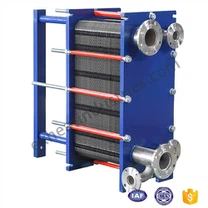
In the petrochemical industry, heat exchanger selection for the reaction process is critical. Today, we will explore the price difference between shell and tube heat exchanger and plate heat exchanger under the same heat exchanger capacity and how to select a more suitable type of heat exchanger.
First, shell and tube heat exchanger
Shell and tube heat exchanger in the petrochemical field has the following advantages:
Strong corrosion resistance: shell and tube heat exchanger is usually made of carbon steel, stainless steel and other corrosion-resistant materials, able to maintain stability in the harsh corrosive environment.
Good anti-freezing performance: shell and tube heat exchanger has enough space inside to add antifreeze and other insulation measures, so it is not easy to freeze in cold environments.
Low failure rate: shell and tube heat exchanger has a simple structure, easy maintenance, stable operation and relatively low failure rate.
However, shell and tube heat exchanger also has some disadvantages:
Relatively low heat transfer efficiency: due to the wide fluid channel of the shell and tube heat exchanger, the fluid flow rate in the pipe is low, resulting in a relatively small heat transfer coefficient.
Larger volume: the main part of the shell and tube heat exchanger consists of a shell and tube bundle, which occupies a larger area and is not flexible enough for occasions with limited space.
In the petrochemical field, shell and tube heat exchanger has become the first choice of many enterprises by virtue of its strong corrosion resistance, good anti-freezing performance, low failure rate and other advantages. However, it has a relatively low heat transfer efficiency and a large volume, which makes it not ideal for certain scenarios.
Second, plate heat exchanger
The advantages of plate heat exchanger in the petrochemical field are as follows:
High heat transfer coefficient: plate heat exchanger adopts high-efficiency corrugated plate structure, which generates strong turbulence when the fluid flows in the channel, thus improving the heat transfer coefficient.
High heat transfer efficiency: Plate heat exchanger has a small size and compact structure, which can provide higher heat transfer efficiency under the same heat transfer area.
However, plate heat exchangers also have some disadvantages:
Relatively poor corrosion resistance: the plate heat exchanger plate is usually made of stainless steel and other corrosion-resistant materials, but corrosion may still occur under certain extreme conditions.
Poor antifreeze performance: plate heat exchanger compact structure, small internal space, it is difficult to add antifreeze and other insulation measures.
Compared with shell and tube heat exchanger, plate heat exchanger has the advantages of high heat transfer coefficient, high heat transfer efficiency and small volume. However, its corrosion resistance is relatively poor, anti-freeze performance is also poor, which to a certain extent limits the scope of its application.
Third, the price difference and selection factors
Material costs: shell and tube heat exchanger using carbon steel, stainless steel and other materials; plate heat exchanger using stainless steel, titanium and other materials. Due to the higher price of stainless steel and other materials, the material cost of plate heat exchanger may be higher.
Manufacturing process: shell and tube heat exchanger manufacturing process is mature, manufacturing costs are relatively low; plate heat exchanger requires sophisticated welding technology and high-quality plate, manufacturing costs may be higher.
Equipment size: the same heat transfer capacity, plate heat exchanger volume is smaller, smaller equipment size; shell and tube heat exchanger volume is larger, larger equipment size.
Brand factors: the price difference between different brands of heat exchangers may also be larger. Well-known brand product quality, service and reputation is better, but the price may be higher.
Fourth, how to choose the right heat exchanger?
In practical applications, should be based on process requirements, equipment investment budget, operating costs, maintenance costs and other factors for comprehensive consideration, choose a more suitable type of heat exchanger.
In short, in the petrochemical field, shell and tube and plate heat exchangers have their own advantages and disadvantages. In the selection of heat exchanger, according to the actual process requirements and conditions, fully compare the price difference between the two types of heat exchangers and performance characteristics, so as to select the most suitable type of heat exchanger. I hope this article can provide you with useful reference in the process of heat exchanger selection!
Remember to pay attention to our WeChat public number, to bring you more professional knowledge and developments in the field of heat exchanger sealing!