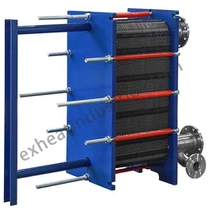
If you want to strike a balance between efficiency and cost to improve overall production and achieve more reliable operation in the long run, here are seven tips that will help you.
1. Optimize your heat exchanger configuration
Start by checking the operating parameters of your heat exchanger. What fluids are flowing, and at what pressures, temperatures, and flows? Heat exchangers are often over-designed, meaning that the engineer adds 10% to all the parameters, and the middleman adds more parameters on top to make sure it doesn't underperform. The result is a heat exchanger with too many plates or one that is designed for a different purpose than it is intended for. So what can you do to fix this and ensure your heat exchanger is the right fit for your specific needs?
Contact a supplier who can perform calculations to check the current operating parameters of your heat exchanger against the design parameters to see if it is configured correctly. Often, you can make adjustments to get better heat transfer efficiency and the right pressure drop. A properly configured heat exchanger will run cleaner and provide the best performance for the system, and can also improve the overall performance of the associated system. For example, a pump won't have to work as hard if the pressure drop is correct.
2. Make sure the exchanger has the right number of plates
Your heat exchanger can have high, low or medium heat transfer plates - or a mix of all three. This means you can reconfigure the exchanger by simply changing the number of plates, without changing the tubes or its frame. You might think that more plates is an efficient way to exchange heat, because more heat transfer area equals better heat transfer, but this is not always the case.
So you can calculate how many plates you need for a particular heat exchanger to achieve the best heat transfer efficiency and pressure drop, and then add or remove plates accordingly.
3. Choose a supplier with a global supply chain
When choosing a supplier, be careful. If you choose a small supplier, the hidden dangers and risks will also be greater. Small companies have limited strength and inventory, and it is easy to have no specific type of plate type, or insufficient stock of gaskets.
It is safer to choose an established global supplier. This supplier has a global supply chain and sufficient resources to meet your parts needs at any time. Large global companies have strong financial support and market influence to support them, and are more trustworthy.
4. Establish a preventive maintenance program
The parts needed to repair a heat exchanger may not be on the shelf when needed. So, once a failure occurs, you may have to race against time to find the required parts (especially if a small supplier is your only option), and must also deal with the impact of a broken heat exchanger. Do you continue production or are forced to shut down when the exchanger is not working? This is the dilemma.
Preventive maintenance is to maintain the heat exchanger before it fails, not after it fails. In the oil and gas industry, the superior form of preventive maintenance for heat exchangers is performance-based maintenance (PbM). PbM is the practice of developing a maintenance plan based on the performance of the heat exchanger around predetermined parameters. Continuously monitor the performance of your heat exchanger, and if the heat transfer efficiency begins to fall below the preset parameters, it is time to perform maintenance.
Establishing a preventive maintenance program should be a standard procedure for any company that relies on heat exchangers. It reduces costs and can also prevent machine failures and unplanned downtime.

5. Start your heat exchanger gently
If you start your heat exchanger up at full flow, there will be an initial shock of water, gas, or oil that can affect gaskets and plate bundles. Sure, the exchanger can handle the flow of liquid, but a 0-100% flow change in a short period of time can still cause damage.
A better approach is to let your heat exchanger fill up slowly, then bleed the air before turning it up to full flow. Treat your heat exchanger well and it will pay you back.
6. Monitor your heat exchanger's operating parameters
You'll know if your heat exchanger is working as expected only if you keep track of its operating parameters. So it's especially important to monitor performance, heat transfer, and pressure drop.
The first step to monitoring the performance, heat transfer, and pressure drop of your heat exchangers is to connect them to temperature and pressure gauges. Study the pressure gauges and take baseline measurements of the cold and hot ends to create a temperature profile. This will give you a clear view of how its overall performance has degraded over time. Continuously observing its performance is also critical to performance-based preventive maintenance because it allows you to identify abnormal heat transfer levels.
By always knowing what it is doing and how it is doing it, you can avoid breakdowns and surprises. It's like putting an activity tracker on your heat exchanger to check its pulse. Every heat exchanger needs an activity tracker.
7. Don't over-tighten your heat exchanger
When a heat exchanger is leaking, you have the option of tightening it. However, over-tightening it can crush its plates, causing the gasket to fail. If you try to open a heat exchanger with crushed plates, it will no longer seal, and you will have to buy a new part.
Therefore, we recommend that you only tighten it to the minimum clamping size. If it is still leaking after doing this, the machine can be repaired.