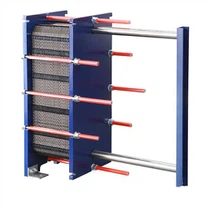
A plate heat exchanger is a heat exchanger formed by stacking a series of metal sheets with a certain corrugated shape. Thin rectangular channels are formed between various plates, and heat exchange is carried out through the plates. Its heat exchange efficiency is high, the heat loss is small, the structure is compact and light, the floor space is small, the installation and cleaning are convenient, and the application is wide.
⒈Plate heat exchanger plates and plate heat exchanger gaskets
⒉Fixed pressure plate
⒊Activity pressure plate
⒋Clamping bolt
⒌Upper guide rod
⒍Lower guide rod
⒎Front and rear columns


2. Principle of operation
The plates of the plate heat exchanger are sealed and guided by sealing gaskets to separate the cold and hot fluid passages. The cold/hot heat exchange medium flows through their respective passages to exchange heat with the separated plates. To reach the temperature required by the user. The four corners of each plate have openings, which are assembled into a plate bundle to form a distribution pipe and a collection pipe for the fluid. After the heat exchange of the cold/heat medium, it flows back from the respective collection pipe and is recycled.
Principle 1: look at the plate type
1. The plate type or corrugated type should be determined according to the actual needs of the heat exchange occasion.
2. In the case of large flow and low pressure drop, the plate type with low resistance should be selected, otherwise, the plate type with large resistance should be selected.
3. According to the fluid pressure and temperature, determine whether to choose a detachable type or a brazed type.
4. When determining the plate type, it is not advisable to choose a plate with a single plate area that is too small, lest there are too many plates, the flow rate between the plates is too small, and the heat transfer coefficient is too low. This problem should be paid more attention to for larger heat exchangers.
Principle 2: Look at the process and flow channel
The process refers to a group of parallel flow channels in the same flow direction of a medium in the plate heat exchanger, and the flow channel refers to the medium flow channel composed of two adjacent plates in the plate heat exchanger. Generally, several flow channels are connected in parallel or in series to form different combinations of cold and hot medium channels.
The process combination form should be calculated based on heat exchange and fluid resistance, and determined under the requirements of process conditions. Try to make the convective heat transfer coefficients in the cold and hot water channels equal or close to get the best heat transfer effect. Because the convective heat transfer coefficient on both sides of the heat transfer surface is equal or close to the heat transfer coefficient to obtain a larger value. Although the flow velocity between the plates of the plate heat exchanger is not equal, the average flow velocity is still used in the calculation of heat exchange and fluid resistance. Since the pipes of the "U"-shaped single process are all fixed on the compression plate, it is convenient to disassemble and assemble.
Principle 3: Look at the pressure drop check
In the design and selection of plate heat exchangers, there are generally certain requirements for pressure drop, so it should be checked. If the check pressure drop exceeds the allowable pressure drop, the design selection calculation needs to be re-calculated until the process requirements are met.