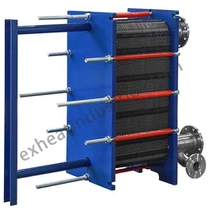
In 2023, plate heat exchanger excelled in technological innovation, mainly in the following aspects:
1. **Development of microchannel heat exchangers**
Microchannel heat exchangers are valued for their high heat transfer efficiency, good controllability and low processing costs. For example, Hangzhou Sanhua Microchannel Heat Exchanger Co., Ltd. demonstrated microchannel heat exchangers with different corrosion-resistant coatings, which showed significant improvements in corrosion resistance and extended life.
2.**New heat exchanger technology innovations**: including pneumatic spraying finned tubes, welded plate tubes, spiral folded plate, twist type, Hitan wire-wound wreaths, group corrugated metal plate type, folded rod type and ultrasonic scale inhibition heat exchanger. These new heat exchangers have obvious advantages in improving heat exchange efficiency, corrosion resistance, high pressure resistance.
3.** Plate heat exchanger technology progress**:
Such as plate heat exchanger unit and the large-scale area of a single piece, the use of gaskets without glue connection technology to reduce the installation and maintenance time, a variety of waveform angle design to meet different pressure drop requirements, as well as the diversity of plate materials.
These innovations indicate that the plate heat exchanger industry is developing towards high efficiency, energy saving, large scale and diversification to meet the needs of different industries and fields. With the continuous progress of technology and the growth of market demand, it is expected that plate heat exchangers will be applied in a wider range of fields and play an important role in energy saving and emission reduction.
Looking ahead to 2024
In 2024, technological innovations in plate heat exchangers are likely to have
significant results in several areas:
1. **Materials and coatings technology**:
New high-performance materials and coatings are being developed to improve heat exchanger corrosion resistance, high temperature resistance, and heat exchange efficiency. For example, the use of advanced nanomaterials or self-cleaning coatings can reduce dirt accumulation and extend equipment life.
2.** Design and structure optimisation**:
Improvements in plate heat exchanger design, such as the use of more efficient corrugated shapes and optimisation of fluid flow paths, are used to increase heat exchange efficiency and reduce pressure loss.
3.**Intelligent and automated**:
Integrated sensors and intelligent control systems enable real-time monitoring and optimised operation of plate heat exchangers. This improves system reliability and energy efficiency and reduces maintenance costs.
4. **Modularity and customisation**:
Developing a modular design makes the heat exchanger easier to customise and deploy quickly to meet specific applications and customer needs.
5. **Energy Saving and Environmental Protection Technologies**:
Research and apply new energy-saving technologies, such as heat pump-assisted heat transfer and waste heat recycling, to reduce energy consumption and environmental impact.
6.** Manufacturing process innovation**:
Adopt advanced manufacturing technologies, such as 3D printing, to improve production efficiency and flexibility of heat exchanger design.
7.** Integration of interdisciplinary technologies**:
Combine the latest research results in the fields of chemical engineering, materials science, thermodynamics and computer science to promote interdisciplinary innovation in heat exchanger technology.
It is believed that 2024 plate exchanger through these innovative directions, the plate heat exchanger industry can not only improve product performance and efficiency, but also to meet the market's growing demand for sustainable development and environmental protection.