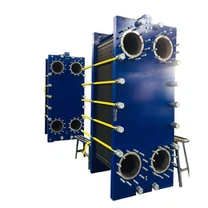
The heat exchange unit is a complete heat exchange station consisting of a heat exchanger, a temperature control valve group, a drain valve group (when the heating medium is steam), a circulation pump, an electric control cabinet, a base, pipelines, valves, instruments, etc.
1. How to determine whether the heat exchanger is blocked?
If the pressure difference between the primary side supply and return water or the pressure difference between the inlet and outlet of the secondary side heat exchanger exceeds 0.15MPa, and the secondary water supply temperature is not hot, please check whether the heat exchanger is blocked. The inspection method is to disassemble and clean the heat exchanger.
2. What are the reasons why the system is not hot? How should it be analyzed?
The temperature of the secondary water supply is low and not hot. The reasons are as follows:
Insufficient water supply flow at the primary side:
Check whether all valves in the primary water supply and return pipes are open.
Check whether the primary water supply filter is clogged.
If the valves are all open, judge the pressure difference between the supply and return water again. If the pressure difference is less than 0.05MPa, ask the heating company to increase the flow rate. If the pressure difference between primary side supply and return water is greater than 0.15MPa, please clean the heat exchanger.
Secondary side system is not smooth:
Check whether all valves in the secondary side water supply and return pipeline are open.
The secondary side filter is clogged.
The pressure difference between the inlet and outlet of the secondary side heat exchanger is higher than 0.15MPa, and the heat exchanger is blocked. Please clean the heat exchanger.
3. There is pressure in the system, but the pressure gauge shows 0. What is going on?
If the needle valve attached to the pressure gauge is closed, the pressure gauge will always display 0. During the operation of the system, ensure that all needle valves supporting the pressure gauge are fully open.
4. What is the overpressure on the secondary side? What to do if there is overpressure? How to prevent secondary system overpressure?
When the system is initially running, the secondary temperature is relatively low. After the water supply reaches the constant pressure value, as the temperature continues to increase, the pressure of the secondary system will also rise. At this time, the first is to exhaust more air, and the second is to Drain water. When draining water, just open the drain valve of the secondary return pipe. Once the system temperature stabilizes, the pressure will no longer increase.
5. How to determine whether the filter is clogged?
If the temperature difference between the primary water supply temperature and the primary return water temperature is large, the high temperature water exceeds 45 degrees, the low temperature water exceeds 30 degrees, and the secondary water supply is not hot, please check whether the filter at the primary water supply is blocked.
If the temperature difference between the secondary water supply temperature and the secondary return water temperature is large, the floor heating temperature difference exceeds 15 degrees, the radiator heating temperature difference exceeds 30 degrees, and the pressure difference is very small, please check whether the filter at the secondary return water is blocked.
6. The unit fault indicator light is on, that is, the yellow indicator light on the control cabinet is on. What should I do?
The fault indicator light lights up to indicate that the corresponding water pump is overloaded, the motor current exceeds the rated current, and the thermal relay plays a protective role. The method to release it is to press the reset button on the thermal relay to reset it. Note that the thermal relay must be reset before it cools down, otherwise the reset will be invalid.
7. Why can't the system replenish water? The water pump keeps turning but the pressure does not rise.
If the make-up pump keeps running but the pressure never reaches the set value, vent the system. Insufficient hydration is mostly caused by air accumulation in the system.
8. What is the reason why the frequency converter does not replenish water automatically and the frequency converter does not start?
Check whether the transfer switch is in the variable frequency or automatic position. The frequency converter must be in the variable frequency or automatic position in order for the frequency converter to work properly.
Check whether the start button of the water replenishing pump is in running state. The inverter can work normally only when the green indicator light of the water replenishing pump is on.
Check whether there is an alarm code on the operation panel of the frequency converter. The number starting with F is the fault code, and the number starting with R is the warning code. The warning code does not affect the operation of the frequency converter. After the fault code appears, the frequency converter must be reset. , the inverter can continue to work. If a fault code appears, press the EXIT key in the upper left corner of the inverter operation screen.
The above three conditions must be normal for variable frequency water replenishment to work properly.
9. What to do when the secondary water supply temperature is too high?
If the user feels that the water supply temperature is too high and the room is too hot, the best way is to turn down the primary water supply valve. Please note that the primary side water supply valve must be closed and the return water valve must be fully open.
10. Why is the water pump making too much noise?
When the unit is running for one or two heating periods, the noise will become louder due to mechanical wear. Check whether the fan cover is loose and exhaust the pump. Water pumps must be maintained regularly, lubricated, wearing parts replaced, etc.
11. Why does the water replenishing pump replenish water frequently and the pressure drops rapidly after stopping?
If the unit frequently replenishes water after running normally for a long time, please do the following checks:
Check whether there are pipeline or valve leaks in the secondary side system, etc.
Check whether the check valve in front of the water replenishing pump is not tight and water flows back. The inspection method is to first stop the water replenishing pump, close the inlet valve of the water replenishing pump, and then open the exhaust valve at the outlet of the replenishing pump. If there is water discharged, it means that the check valve in front of the replenishing pump is not tight and needs to be replaced.
12. What happens when one circulation pump is turned on and the other circulation pump is also running?
During the operation of the unit, if one circulating pump is turned on and the other circulating pump also rotates in reverse, it means that the check valve in front of the pump that is not turned on is not tight and the check valve needs to be replaced. If it cannot be replaced temporarily, please close the butterfly valves at the front and rear of the pump to prevent water from flowing back.
13. If the unit is equipped with a canned pump, how to determine whether the direction of the pump is correct?
The most reliable way to judge whether the direction of the canned pump is correct is to use a clamp-type ammeter to measure the current. The forward current is greater than the reverse current.
14. The pump start-up indicator light is on, but the pump is not running. What is going on?
Check the circuit breakers in the control cabinet and make sure they are in the suction state.
15. The pressure difference between the inlet and outlet of the circulating pump exceeds the head of the circulating pump. What's going on?
The pressure difference between the inlet and outlet of the circulation pump represents the resistance of the entire system. For example, the inlet pressure of the circulating pump is 0.25MPa and the outlet pressure of the circulating pump is 0.55MPa, which means that the resistance of the entire system is 0.3MPa. This resistance includes the resistance of the unit itself. If the pressure difference between the inlet and outlet of the circulating pump has exceeded the head of the circulating pump, it means that the secondary water supply pipeline is seriously blocked, resulting in ultra-high secondary water supply pressure. It is normal for the inlet and outlet pressure of the circulating pump not to exceed the head of the circulating pump.
16. The temperature difference between the water supply temperature and the return water temperature exceeds the rated value. What's going on?
The smaller the temperature difference between the water supply temperature and the return water temperature, the greater the flow rate of the system and the smoother the system. On the contrary, if the temperature difference between the supply water temperature and the return water temperature is larger (exceeding the rated value), it means that the flow rate of the system is small and the system circulation is not smooth enough. At this time, check whether the filter and heat exchanger and the corresponding valves in the pipeline are blocked.