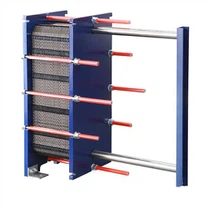
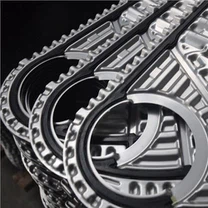
Cause analysis and treatment of common failures of plate heat exchanger
Common failures of plate heat exchangers include liquid leakage, external leakage, excessive pressure drop, and heating temperature that cannot meet the requirements.
One, string liquid
1 Cause
① Due to improper selection of plates, cracks or perforations are caused by corrosion of plates.
②The operating conditions do not meet the design requirements.
③The residual stress after cold stamping of the plate and the clamping size during assembly are too small to cause stress corrosion.
④ There is a slight leakage in the plate leakage groove, which causes the harmful substances in the medium to concentrate and corrode the plates, forming a string of liquid.
2 Processing method
① Replace the cracked or perforated plate, and use the light transmission method to find the crack of the plate on the spot.
②Adjust the operating parameters to meet the design conditions.
③The clamping size of the heat exchanger should meet the requirements during maintenance and assembly, not as small as possible.
④ Reasonable matching of plate materials.
Two, leakage
1 Cause
①The clamping size is not in place, the size is uneven everywhere (the size deviation should not be greater than 3 mm) or the clamping bolts are loose.
② Part of the gasket is out of the sealing groove, there is dirt on the main sealing surface of the gasket, the gasket is damaged or the gasket is aging.
③ The plate is deformed, and the assembly misalignment causes the running mat.
④ There are cracks in the sealing groove of the plate or the second sealing area.
2 Processing method
① In the no-pressure state, re-clamp the equipment according to the clamping size provided by the manufacturer. The size should be uniform and the deviation of the compacted size should not exceed ±0.2N (mm) (N is the total number of plates). The parallelism between the plates should be kept within 2 mm.
② Mark the leaking parts, then disassemble the heat exchanger and investigate and solve them one by one, and reassemble or replace the gaskets and plates.
③ Disassemble the open heat exchanger, repair the deformed parts of the plate or replace the plate. When there is no spare part for the plate, the plate at the deformed part can be temporarily removed and then reassembled for use.
④ When reassembling the disassembled plates, clean the plate surface to prevent dirt from adhering to the gasket sealing surface.
Three, the pressure drop is too large
1 Cause
①The pipeline of the operating system has not been purged normally, especially many dirt (such as welding slag) in the pipeline of the newly installed system enters the inside of the plate heat exchanger. Due to the narrow cross-sectional area of the plate heat exchanger, the heat exchange The sediment and suspended matter in the vessel gather at the corner holes and the diversion area, which causes the flow channel area to be greatly reduced, causing the main pressure loss in this part.
② When the plate heat exchanger is selected for the first time, the area is too small, which causes the flow velocity between the plates to be too high and the pressure drop is too large.
③ After the plate heat exchanger has operated for a period of time, the pressure drop is too large due to fouling on the surface of the plate.
2 Processing method
①Clean the dirt or plate fouling in the flow channel of the heat exchanger. For the newly operating system, clean it once a week according to the actual situation.
② It is better to use softened water for the secondary circulating water. Generally, the suspended solids concentration in the water should not be greater than 5 mg/L, the impurity diameter should not be greater than 3 mm, and the pH ≥ 7.
When the water temperature is not more than 95℃, the concentration of Ca and Mg should not be more than 2 mmol/L;
When the water temperature is greater than 95°C, the concentration of Ca and Mg should not exceed 0.3 mmol/L, and the mass concentration of dissolved oxygen should not exceed 0.1 mg/L.
③For the central heating system, the method of replenishing water once and twice can be used.
Fourth, the heating temperature cannot meet the requirements
1 Cause
① Insufficient medium flow on the primary side causes a large temperature difference on the hot side and a small pressure drop.
②The cold side temperature is low, and the temperature at the cold and hot ends is low.
③The flow distribution of multiple plate heat exchangers operating in parallel is uneven.
④The internal scale of the heat exchanger is serious.
2 Processing method
① Increase the flow rate of the heat source or increase the diameter of the heat source medium pipeline.
② Balance the flow of multiple plate heat exchangers operating in parallel.
③ Disassemble the plate heat exchanger to clean the surface of the plate fouling.