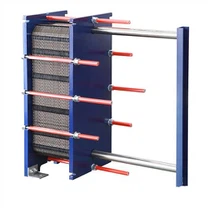
The most typical dividing wall heat exchanger has a long history of industrial application, and it still occupies a dominant position in all heat exchangers. The main structure is composed of heat exchange plates and rubber strips between the plates. It has dominated the market for a long time, but its volume is large, the heat exchange efficiency is low, and the replacement of the rubber strip is expensive (the replacement cost of the rubber strip accounts for about 1/3-1/2 of the entire process).
It is mainly used in the heat exchange between liquid and liquid. It is often called water-to-water heat exchange in the industry, and its heat exchange efficiency is 5000w/m2.K. In order to increase the heat-supply coefficient of the fluid outside the tube, a certain number of transverse baffles are usually installed in the shell. The baffle plate can not only prevent the fluid from short-circuiting and increase the fluid velocity, but also force the fluid to flow through the tube bundle multiple times according to the prescribed path, which greatly increases the degree of turbulence. Commonly used baffles are round and disc-shaped, and the former is more widely used. Due to the launch of China's new version of GMP, plate heat exchange will gradually withdraw from industries with high sanitation levels such as food, beverages, and pharmaceuticals.