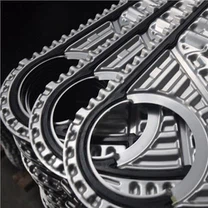
Plate heat exchangers for ships, which we call marine heat exchangers, are mainly used in cruise ships, LPG ships, container ships, bulk carriers, and engineering ships. The main applications include central cooling systems (high and low-temperature freshwater cooling), diesel engine cooling, preheating, cylinder liner cooling, lubricating oil cooling, heavy fuel oil preheating, seawater desalination, etc.
First, Marine heat exchanger working principle
The marine heat exchanger and the general structure of the heat exchanger equipment are the same, in stainless steel, titanium, and another corrosion-resistant metal sheet, with a press flat press molding and with the design of the corrugation, in its surroundings with synthetic rubber gasket sealing, to form a " heat transfer plate ". The required number of these plates are draped over the guide rods and overlapped between the fixed and moving frames made of sheet steel, which are held in place by screws. The high-temperature fluid medium and the low-temperature fluid medium are separated by a piece of interactive flow in the flow path formed between the plates for heat exchange.
Because it is an ocean-going operation, all equipment must ensure stability, while the marine heat exchanger has stable performance, long service life, easy installation, smaller footprint, and higher heat exchange efficiency while making less scaling; in addition, is the use of special material titanium plate, can prevent seawater for the corrosion of the plate, extend the use of cycle, from a long-term perspective, cost savings. In the marine industry, the marine plate heat exchanger of high efficiency and quality, safe and reliable, for the normal work of the ship's turbine plays an important role.
Second, the marine heat exchanger application
1,Cooling system, the central cooling system is divided into high-temperature hot fresh water and low-temperature warm fresh water closed system. The former is used to cool the main engine, the latter is used to cool the hot fresh water and various coolers. The heated warm fresh water is cooled in a central cooler by an open seawater system. Thus, only one cooler with seawater as coolant is used, simplifying the arrangement of the seawater piping system. The seawater and freshwater pipelines are separated in the central cooling system, resulting in less corrosion and clean freshwater pipelines, low management costs, and strong system work reliability; the high-temperature and low-temperature freshwater channels cool different ship equipment separately, making the system adaptable and improving equipment work performance.
2,Propulsion system, including lubricating oil system, jacketed water system (open and closed) fuel system, and other operating sub-systems. All these systems are heated as energy is generated and the temperature is controlled using heat exchangers within the system for cooling. Through heat transfer, heat is transferred from the engine coolant to the ship's circulating water. In this way, the engine coolant is kept in the right temperature range to avoid damage to the engine from overheating and overcooling, and also to raise the efficiency of the engine.
3. Freshwater systems, to produce fresh water, use seawater condensers and jacketed evaporators, both of which are types of heat exchangers. In the freshwater generator, the main role of the marine heat exchanger is to desalinate seawater by transferring heat between high-temperature and high-pressure seawater and low-temperature and low-pressure fresh water, allowing the salt in the seawater to condense and separate. In addition, heat recovery can be achieved and the waste heat generated can be reused to increase energy efficiency. The application of marine heat exchangers in freshwater generators therefore plays an important role in ensuring the safety of life and navigation at sea.