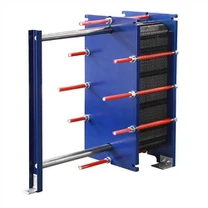
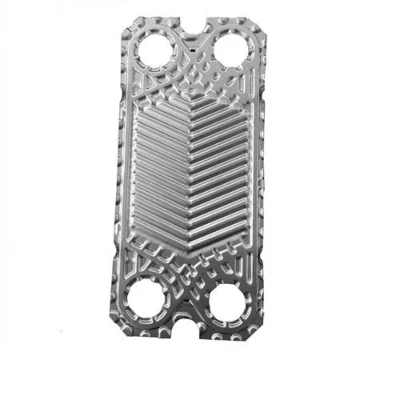
The marine plate heat exchanger as the main heat exchange equipment on the ship plays a key role in the safe operation of the entire ship. Its structure is relatively simple compared to other equipment, mainly composed of screw, pressure plate, base, plate and so on. It is widely used as liner water, lubricating oil cooler and central cooler for the main engine of large ships. It has been greatly developed in the past few decades. Major manufacturers are focusing on how to improve the heat exchange effect of marine plate heat exchangers.
Because the plate structure of the marine plate heat exchanger directly affects the performance of the heat exchanger. This article will discuss the influence of a series of plate parameters of the existing marine plate heat exchanger on the performance of the heat exchanger, in order to provide some reference for further research.
For the maintainability of marine plate heat exchangers, the plates are connected in a U-shape, which is a counter-current method, and the fluid on both sides is cold water and hot water or lubricating oil. The heat exchange form between the plates can be abstracted as flat wall heat transfer. Since the flow of fluid in the channel of the marine plate heat exchanger is determined by the heat exchange of the main engine diesel engine lubricating oil or liner water, the focus of the study can be on the plate form.
What are the main factors affecting the heat transfer effect of the plate
1.Plate thickness
2.Angle of plate
3.Flow rate between plates
Plate thickness
It can be seen from the expression of the heat transfer coefficient that the smaller the thickness δ of the plate, the better the heat transfer effect of the heat exchanger. The standard for marine plate heat exchangers proposes that the plate thickness of the heat exchanger is 0.6~0.8mm. The thinnest titanium plate in the industry has reached 0.4mm. Thinning the plate will not be too obvious to improve the heat exchange effect, but the main purpose is to reduce the cost and reduce the consumption of materials, but the strength of the thin plate will be relatively reduced after pressing.
Angle of plate
One of the main methods to increase the value of k in marine plate heat exchangers is to increase the degree of fluid disturbance on the surface of the heat exchange medium on both sides of the plate. The plates of marine plate heat exchangers are usually processed into herringbone corrugated plates. For the herringbone corrugated sheet, the size of the herringbone angle has a great influence on heat transfer and fluid resistance. Plates with large herringbone angles have high heat transfer coefficient and high fluid resistance; conversely, plates with small herringbone angles have low heat transfer coefficient and resistance. The 120° herringbone angle has the best heat transfer effect. The smaller or larger the angle, the lower the heat transfer efficiency. The usual central cooler and liner water cooler use 120° herringbone plates to achieve the maximum The heat transfer effect.
Flow rate between plates
The flow rate of the fluid flowing between the plates is not uniform. The flow rate on the main flow line is about 4 to 5 times the average flow rate. The flow rate of each flow channel in a process is not uniform. In order to make the fluid flow between the plates, out of a fully turbulent state, it is advisable to take the average flow velocity between the plates 0.3-0.8m/s. Take a larger value when the resistance drop is allowed to increase the convective heat transfer film coefficient, thereby reducing the heat exchange area and improving the heat exchange efficiency. Usually select the appropriate single-piece area and aspect ratio of the plate according to a given flow rate. This selection method is a key factor in controlling the flow rate between the plates.
(1) Through the heat transfer model of the heat exchanger, several key factors affecting the heat transfer coefficient k of the heat exchanger are analyzed: heat transfer film coefficient α and plate thickness δ. The characteristic length of the plates and the Reynolds number Re between the plates determine the size of the heat transfer film coefficient α.
(2) The current research direction of marine plate heat exchanger plates (plate thickness, plate angle and inter-plate flow velocity) is analyzed in detail.
(3) After analysis, it is necessary to improve and optimize the marine plate heat exchanger based on the relevant principles of heat transfer and fluid mechanics in the subsequent work.