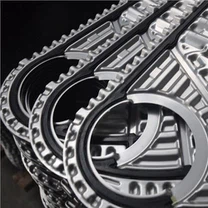
The application of heat exchangers in the oil refining industry is very extensive, and its importance is obvious. The utilization rate of heat exchange equipment directly affects the efficiency of the oil refining process and the cost of the problem. According to statistics, heat exchangers account for about 1/5 of the investment in chemical construction. Therefore, the utilization rate and life of heat exchangers are important issues worth studying. From the point of view of the damage of the heat exchanger, corrosion is a very important cause, and the corrosion of the heat exchanger is widespread. Solving the corrosion problem is equivalent to solving the root of the damage of the heat exchanger. To prevent the corrosion of the heat exchanger, it is necessary to figure out the root cause of the corrosion. Now the reasons for the corrosion of the heat exchanger are discussed from the following aspects.
corrosion
1. The choice of material for the heat exchanger is the decisive factor for its economy. The tube materials include stainless steel, copper-nickel alloy, nickel-based alloy, titanium and zirconium, etc., except for the case where welded tubes cannot be used in industry. Welded tubes are used, corrosion-resistant materials are only used for the tube side, and the shell side material is carbon steel. 2. Metal corrosion of heat exchanger 2.1 Principle of metal corrosionMetal corrosion refers to the destruction of metal under the chemical or electrochemical action of the surrounding medium, and often under the combined action of physical, mechanical or biological factors. That is, the metal is destroyed under the action of its environment. 2.2 Several common types of corrosion damage of heat exchangers 2.2.1 Uniform corrosion The macroscopic uniform corrosion damage is called uniform corrosion on the entire surface exposed to the medium, or on a larger area. 2.2.2 Contact corrosion When two metals or alloys with different potentials are in contact with each other and immersed in the electrolyte solution, a current flows between them. The corrosion rate of metals with positive potentials decreases, and the corrosion rate of metals with negative potentials increases. 2.2.3 Selective corrosion The phenomenon that an element in the alloy preferentially enters the medium due to corrosion is called selective corrosion. 2.2.4 Pitting Corrosion Concentrated on individual small points on the metal surface with a large depth is called pitting corrosion, or small hole corrosion, pitting corrosion. 2.2.5 Crevice Corrosion Severe crevice corrosion will occur in the crevices and covered parts of the metal surface. 2.2.6 Erosion erosion Erosion corrosion is a kind of corrosion that accelerates the corrosion process due to the relative movement between the medium and the metal surface. 2.2.7 Intergranular corrosion Intergranular corrosion is a kind of corrosion that preferentially corrodes the grain boundary and the area near the grain boundary of the metal or alloy, and the grain itself corrodes relatively less. 2.2.8 Stress Corrosion Cracking (SCC) and Corrosion Fatigue SCC is a material fracture caused by the combined action of corrosion and tensile stress in a certain metal-medium system. 2.2.9 Hydrogen damage Metal in the electrolyte solution, due to corrosion, pickling, cathodic protection or electroplating, can cause damage caused by hydrogen permeation. 3. The influence of cooling medium on metal corrosion The most used cooling medium in industry is various natural water. There are many factors that affect metal corrosion. The main factors and their effects on several commonly used metals: 3.1 Dissolved oxygen Dissolved oxygen in water is an oxidant that participates in the cathodic process, so it generally promotes corrosion. When the concentration of oxygen in the water is not uniform, an oxygen concentration difference battery will be formed, causing local corrosion. For carbon steel, low alloy steel, copper alloy and some grades of stainless steel, molten oxygen is the most important factor affecting their corrosion behavior in water. 3.2 Other dissolved gases CO2 will cause corrosion of copper and steel when there is no oxygen in the water, but will not promote the corrosion of aluminum. A small amount of ammonia corrodes copper alloys, but has no effect on aluminum and steel. H2S promotes the corrosion of copper and steel, but has no effect on aluminum. SO2 reduces the pH value of water and increases the corrosivity of water to metals. 3.3 Hardness Generally speaking, the increased hardness of fresh water reduces the corrosion of metals such as copper, zinc, lead and steel. Very soft water is very corrosive. In this kind of water, copper, lead, and zinc are not suitable. On the contrary, lead is resistant to corrosion in soft water and produces pitting corrosion in water with high hardness. 3.4 pH value Steel corrosion is small in water with pH>11, and corrosion increases when pH<7. 3.5 The influence of ions Chloride ions can damage the surface of passivated metals such as stainless steel and induce pitting corrosion or SCC. 3.6 The influence of scale CaCO3 scale in fresh water. The CaCO3 scale layer is not good for heat transfer, but it helps prevent corrosion. 4. The influence of heat transfer process on corrosion The corrosion behavior of metals is different under the conditions of heat transfer and no heat transfer. Generally speaking, heat transfer intensifies corrosion of metals, especially under conditions of boiling, vaporization or overheating. In different media, or on different metals, the effect of heat transfer is different. 5. Anti-corrosion method Knowing the causes of various corrosion of heat exchangers, and choosing anti-corrosion measures reasonably, can we achieve the purpose of efficient use of equipment.