Overview
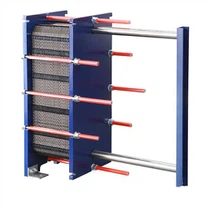
In the industrial production of petroleum, chemical industry, light industry, pharmacy, energy, etc., heat exchangers are often used to heat low-temperature fluids or cool high-temperature fluids, vaporize liquids into steam or condense steam into liquids. The heat exchanger can be a unit of equipment, such as heaters, coolers, and condensers; it can also be a component of a process equipment, such as the heat exchanger in an ammonia synthesis tower. The heat exchanger is an important unit equipment in chemical production. According to statistics, the tonnage of the heat exchanger accounts for about 20% of the entire process equipment and some even as high as 30%. Its importance can be imagined.
Shell and tube
Shell-and-tube heat exchanger is a large quantity and a wide variety of products, and there is an urgent need for new wear-resistant, corrosion-resistant, and high-strength materials. my country has made different degrees of progress in the development of stainless steel copper alloy composite materials, aluminum-magnesium alloys and silicon carbide and other non-metallic materials, among which titanium materials have developed rapidly. Titanium has better corrosion resistance to seawater, chlor-alkali, acetic acid, etc. If heat transfer is strengthened, the effect will be better. Some manufacturing units have better mastered the processing and manufacturing technology of titanium. For spraying materials, my country has introduced production lines from abroad. Aluminum-magnesium alloy has high corrosion resistance and thermal conductivity, and the price is cheaper than titanium, so attention should be paid. Remarkable achievements have been made in domestic research on improving the performance of heat exchangers, increasing heat transfer efficiency, reducing heat transfer area, reducing pressure drop, and increasing the thermal strength of the device. The large-scale use of heat exchangers effectively improves the utilization rate of energy, reduces the cost of the enterprise and improves the efficiency.