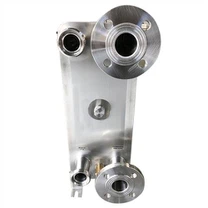
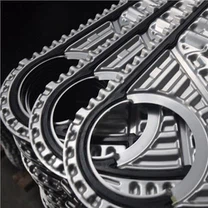
Plate heat exchanger in addition to the special circumstances of the maintenance, should also be regular maintenance. Because of the plate heat exchanger disassembly and installation is easy, simple maintenance, and generally do not use special tools and equipment. According to different situations can be used in different ways, if the equipment does not occur leakage, only the heat transfer system K has fallen, it can not be disassembled heat exchanger, and a closed-circuit system to descale the liquid into the equipment can be circulated for several hours. The site does not have such conditions, and disassemble the equipment or found that the scaling is not too serious, may not take off the plate and water directly flush, while using a soft brush can be brushed.
I. Normal operation and maintenance
① need to repair the equipment, should be installed in reverse order to disassemble the heat exchanger.
② Equipment used in the petroleum and chemical industries should be regularly maintained according to the maintenance cycle.
③ equipment in the medium if it is flammable, explosive or corrosive media, should be repaired at least once a year.
④ plate heat exchanger used in other industries, if no leakage occurs, it is best to repair once every three years.
Second, the plate cleaning and protection to keep the plate clean is one of the important conditions to maintain a high heat transfer coefficient. Between the plates, the medium is along the narrow zigzag flow channel movement, even if the generation of less thick layer of scale, will also cause changes in the flow channel, significantly affecting the fluid movement, so that the pressure drop increases, the heat transfer coefficient decreases, for example, a sugar plant in the use of plate heat exchanger in heating, due to the secondary water is not well treated, the use of only two months in the process of blocking the flow channel, can not continue to run.
1, chemical cleaning method this method is a chemical solution circulated through the heat exchanger, so that the plate surface dirt dissolved, discharged. This method does not require disassembly of the heat exchanger, simplifying the cleaning process, but also to reduce the degree of cleaning labor. As the plate corrugation can promote cleaning fluid turbulence, conducive to the dissolution of the scale layer, so the chemical cleaning method is a more ideal method.
2, mechanical (physical) cleaning method this method is the plate sheet after the manual scrubbing with a brush, so as to achieve the purpose of removing the plate sheet surface dirt. Although this method is more direct, but the harder, thicker layer of dirt, not easy to clean.
3, comprehensive cleaning method for the dirt layer is harder and thicker, simply using one of the above methods are difficult to clean. Comprehensive method is the first chemical cleaning method to soften the scale layer, and then mechanical (physical) cleaning method to remove the scale layer, in order to keep the plate clean.
4、Cautions when cleaning
① chemical cleaning solution to maintain a certain flow rate, generally 0.8 ~ 1.2m / s. Its purpose is to increase the degree of turbulence in the solution.
② For different dirt should use different chemical cleaning solution. In addition to the often used dilute soda ash solution, for scale available 5% nitric acid solution. In the soda ash production generated by the scale, available 5% hydrochloric acid solution. But shall not use the chemical detergent that produces corrosion on the plate.
③ mechanical (physical) cleaning does not allow the use of carbon steel brushes to wash the stainless steel sheet, so as not to accelerate the corrosion of the plate. At the same time can not make the plate surface scratches, deformation, etc.
④ The cleaned plate should be rinsed with water and dried, and the plate should be placed to prevent deformation.
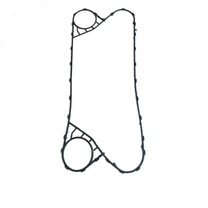
Third, the characteristics of the gasket and its replacement due to the expanding field of application of plate heat exchangers, for different media and processes have different temperature, pressure and corrosion resistance requirements. Want to use a bell "universal" gasket to adapt to all cases, it is obviously impossible, but should be used for different cases of different materials gasket. The common gasket cross-sectional shape is hexagonal. The common types of gaskets are natural rubber, neoprene, EPDM, silicone rubber, fluoroelastomer, asbestos fiber board, etc. Plate heat exchanger gasket in use if leakage, fracture, aging and other phenomena, to be replaced in a timely manner. Replacement should be carried out in the following order. ① Remove the used gaskets. Note that when dismantling, do not make the gasket groove with scratches.
② Use acetone, butanone or other ketone solvents to remove the residual glue in the gasket groove.
③ Clean the gasket slot and gasket with clean cloth or cotton sassafras.
④ Apply the adhesive evenly in the gasket groove.
⑤ Put the new clean gasket on the board.
⑥ Place the gasketed board in a flat, cool and ventilated place to dry naturally before installing and using.