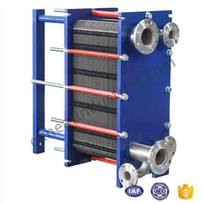
| Product Information of gasketed plate heat exchanger | |
| Brand | Exheat |
| Plate material | Titanium/Stainless steel 0.5mm 0.6mm 0.7mm 0.8mm 1mm |
| Gasket material | NBR HNBR EPDM HEPDM VITON FKM Silicone |
| Frame material | Painted Carbon steel or stainless steel |
| Color of frame | blue or customed color |
| Connection type | flange or thread |
| Flange standard | ANSI ASME BS BA JIS DIN GB ISO |
| Tightening bolt | M24 M30 M39 |
| Design pressure | highest 20mpa, lowest 10Mpa |
| Work pressure | normal 12.5Mpa |
| MOQ | 1 set |
| Package | polywood case |
| Warranty | one year |
| OEM | Can make replacement |
1.Wine Production Process Flow
Harvest grapes → Prepare grapes →Pasteurization →Add yeast→Fermentation→Press→Malolactic→Aging→Blending →Pasteurization→Bottling→Bottle aging

2.process stages
1. Selection of raw materials: ripe, fresh, whole grapes. The grape varieties suitable for vinification are listed in the table below.
2. Washing and sorting: wash the selected grapes in a vat of running water. Rinse well with water. While washing, rotten berries are sorted and removed.
3. Pressing and coarse filtration: juice is extracted by pressing and centrifugation. Coarse filtration is carried out using a 0.5 mm pore size sieve to reduce insoluble solids to less than 20%.
4. Low-temperature maceration: control room temperature to 5-10°C and extract flavonoid polyphenols for approximately 12-24 hours.
5. Low-temperature clarification: rest at 0-5°C to remove suspended solids such as pulp and skins, reduce enzyme activity and prevent unrefined acidity.
6. Pasteurisation: rapid heating to 90-95°C to inactivate different enzymes.
7. Heat maceration: rapid and short leaching of tannins and grape pigments at 50-60°C.
8. Fermentation: different wines require different temperatures for fermentation. Dry white wines are fermented at around 18-20°C and dry red wines at around 26-30°C.
9. Refrigeration: the wine is chilled to allow the sodium hydrogen tartrate to precipitate out.
10. Packaging: the sterilised wine is quickly placed in sterilised, heat-sealed glass bottles. After sealing, the wine is rapidly cooled to 38°C.
Hot Tags: plate heat exchangers for wine, China, suppliers, manufacturers, cheap, pricelist, low price, for sale, plate heat exchanger research paper, plate heat exchanger spare parts service, 80 plate heat exchanger, 70 plate heat exchanger, 150k capacity heat exchanger, plate heat exchanger kit