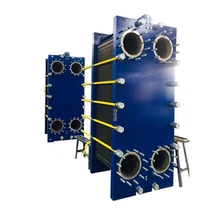
Some problems existed in the application of plate heat exchanger in refrigeration equipment
At present, plate heat exchanger has been used in small refrigeration (cooling water) equipment, and its application will be further expanded. This is mainly due to the excellent heat exchange performance of plate heat exchanger, small volume, light weight, and the continuous improvement of the safety and reliability of plate heat exchanger. On the whole, the practical application effect is good. However, there are some problems.
Because the plate heat exchanger has a strong heat exchange capacity (its heat transfer coefficient is several times of the conventional heat exchanger, the heat exchange area per unit volume is large), and small volume, light weight. Therefore, it has been favored by researchers and users. However, the pressure resistance and sealing performance of plate heat exchanger are not good, which restrict the application of plate heat exchanger in engineering.
Previously, the plate heat exchanger is mainly used in the cleaner working medium, the working pressure is not too high, the leakage requirements are not too harsh, the leakage will not have a great impact on the environment and the working medium between the equipment, such as applied in the civil hot water exchange system and steam hot water exchange system.
At present, the refrigeration equipment using plate heat exchanger, mainly some small equipment, mainly imported brazed plate heat exchanger. As for the use of a separate plate heat exchanger on the condenser and evaporator of a large chiller, it is theoretically feasible, but we have not seen relevant reports. That is to say, people have some concerns about the further popularization and application of plate heat exchanger in the refrigeration industry, and its safety and reliability and related problems need to be further solved.
Now take a set of refrigeration equipment in use as an example for analysis
The equipment uses two 7.5-inch Meyule air cooling units working in parallel to produce cold water to produce fresh beer insulation tank, insulation tank cooling, adding antifreeze in the cold water to control the freezing point at about -6℃, cold water temperature control point is set at the plate evaporator inlet, control temperature of 2~4℃.
The main problem of this set of equipment is the plate evaporator freezing block. The system runs normally under high temperature conditions, but it is easy to freeze block under low temperature conditions (when the inlet temperature is about 2℃ and the unit is about to shut down). When the plate evaporator freezes, the working condition deteriorates sharply, and the whole inside of the plate evaporator can be frozen in a very short time.
The plate heat exchanger is fatal to the plate heat exchanger, because the plate heat exchanger is a relatively delicate equipment, the thickness of the heat exchange sheet is very small, can not withstand the impact of external force, when the freezing blockage occurs, ice crystal expansion will directly cause the heat exchanger internal deformation or leakage. It has great influence on the operation and production of refrigeration equipment
Analysis of problems
First, the refrigeration system is not matched, the evaporator is small; Or because of the long-term operation of the unit, the heat exchange capacity of the plate evaporator decreases due to scaling and fouling inside the evaporator. Resulting in low evaporation temperature (-10℃) in the actual operation process.
1. The evaporation temperature is lower than the freezing point of cold water, which increases the possibility of freezing blockage of plate evaporator.
2, the evaporator heat transfer temperature difference is large, does not give full play to the advantages of plate evaporator itself, is not conducive to the improvement of refrigeration efficiency. When the cold water inlet temperature is 2℃ (the temperature difference between the water in and out of the evaporator is 5℃), the evaporator outlet temperature is -3℃, and the heat transfer temperature difference is 9.3℃. Because the plate evaporator has a high heat transfer coefficient, its heat transfer temperature difference should be at least smaller than the conventional heat exchanger, for example, choose about 2℃.
Two, cold water freezing point is high. When the evaporator runs at the low temperature point (inlet temperature 2℃), the outlet temperature is only 3℃ higher than the freezing point. That's not to say it won't be allowed in practice, but it does raise the possibility of ice jams, requiring more precise temperature control. In addition, the cold water near the freezing point has large viscosity and poor liquidity, and the flow section of the plate evaporator unit is small, so it is more suitable to use the working medium with good liquidity. Therefore, if feasible, measures should be taken to reduce the freezing point, increase the outlet temperature of cold water, and increase the flow of cold water.
Three, the control device is not perfect. The start and stop of the cold water pump are not interlocked with the operation of the refrigeration system, and the cold water flow and pressure drop of the evaporator are not tested and controlled. Although the refrigeration system has a low pressure controller, it is only used to control the zero pressure shutdown of the compressor (to prevent the plate evaporator from bearing high pressure when the equipment is out of service for a long time) and there is no low pressure operation protection. Once the pump is stopped or the water flow in the evaporator is reduced due to dirty plugging, ice plugging will occur.
Four, improper maintenance.
1. The inlet temperature control has been in disrepair for a long time, the displayed value is about 1.5℃ lower than the actual value, and the instrument is too inert to reflect the real temperature of cold water inlet in time. In the actual operation process will cause cold water divisor temperature close to the freezing point and the unit is still not shut down.
2. Although the plate evaporator is equipped with an anti-freezing and blocking temperature control device, the anti-freezing and blocking device often has no action because ice blocking has occurred. Because the cold water outlet temperature is very close to the freezing point, it is not easy to adjust it to the best control point.
Five, the lack of refrigerant in the system will also cause freezing blockage. This is different from conventional evaporator. The reason is related to the structure of plate evaporator. Plate heat exchanger is composed of many very narrow unit channels superimposed, each unit in the cold water or refrigerant flow is very small, heat exchange sheet is very thin, heat exchange ability is very strong. When the system is short of refrigerant, it will cause uneven refrigerant distribution in each unit channel, at this time the evaporation pressure is very low, and the limited number of units due to intense heat exchange and ice blocking, and then cause the blockage of the adjacent unit channel, causing a chain reaction, ice blocking is intensified until the whole evaporator is completely frozen.