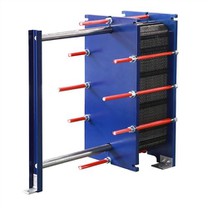
Structural characteristics of plate heat exchanger gaskets
Plate heat exchanger plates are divided into unilateral flow and diagonal flow according to their heat exchange medium flow patterns. Correspondingly, plate heat exchanger gaskets are divided into unilateral flow and diagonal flow according to heat exchange medium flow patterns. Stream 2 kinds.
Unilateral flow means that the heat exchange medium flowing in from the right corner hole of the heat exchange plate finally flows out from the right corner hole. Similarly, the heat exchange medium flowing in from the left corner hole finally flows out from the left corner hole. Diagonal flow means that the heat exchange fluid flows from the right corner hole and then flows out from the left corner hole, or the fluid flowing in from the left corner hole flows out from the right corner hole, showing a diagonal flow pattern. In terms of heat exchange efficiency, the diagonal flow method is better than the unilateral flow method, but the cost of the unilateral flow method is relatively low, so when the heat exchange efficiency can be met, the unilateral flow method is generally adopted.
Plate heat exchanger gaskets can be divided into 3 types according to the installation method on the heat exchange plates
(1) Direct glue type, that is, after applying sealant on the sealing gasket, it is directly glued to the installation groove of the heat exchanger plate.
(2) The snap in type is that the heat exchange plate is designed with assembly holes, and the rubber nails are designed on the side of the sealing gasket. After the sealing gasket is placed in the installation groove, the rubber nails are inlaid in the assembly hole.
(3) Snap-on type, is to design a buckle on the side of the gasket, and use the buckle to buckle the gasket on the heat exchange plate.
For the above three methods, the adhesive gasket has a simple structure and is the easiest to process, but it is relatively troublesome to install and disassemble. Inlaid and snap-mounted gaskets are complicated in structure and cumbersome to process, but they are relatively easy to install and disassemble. Plate heat exchanger gaskets are divided into symmetrical and asymmetrical shapes according to the product's cross-sectional shape. Symmetrical shapes are generally used for diagonal flow plates. The upper and lower sealing surfaces
Gasket material Use temperature °C Suitable for fluids
Nitrile rubber (NBR) -15~+135 Water, sea water, mineral oil, salt water
EPDM (EPDM) -25~+180 Hot water, steam, acid, alkali
Viton (F26) -55~+230 Acid, alkali, fluid
Tetrapropylene fluorine rubber 0~+160 Concentrated acid, alkali, high temperature oil, steam