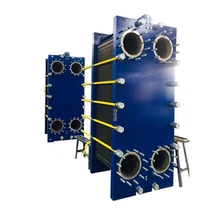
Heat transfer plate is the core component of heat exchanger. Plate forming process and material properties Sealing and heat transfer efficiency will have a direct impact.
The heat exchanger usually uses water as the cooling medium. Most of the plate is made of stainless steel sheet. In the plate is embossed with corrugated runners. The space between two adjacent plates is the media flow channel. Cold and hot fluid in the plate on both sides of the flow. Heat exchange through the plate.
It can be said that the heat transfer plate is the plate heat exchanger "soul"! Plate exchange industry practitioners are well aware of the four characteristics of the heat transfer plates.
Design of triage areas
Even with the widest plate, can also make the fluid fully and evenly distributed in all corners of the plate, The pressure loss in the shunt area is minimised.
All the heat transfer area of the plate is involved in efficient heat transfer.All the physical area of the plate is converted into effective heat transfer area.No heat transfer dead zone.There is no flow dead corner.Not easy to accumulate scale.Chlorine ion corrosion caused by scale build-up is not easy to occur.Allowable pressure drop can be fully utilised.Increase the flow rate of convection heat exchange part. Improve the overall heat transfer efficiency.
single-side flow design
The whole plate heat exchanger uses only one kind of plate.Easier piping.Easier installation and equipment maintenance.Reduce the types and quantity of spare parts for plates and rubber gaskets.
There are Two Kinds of H and L Corrugation Angle
Through the optimised combination of heat exchanger plates Maximise the heat transfer coefficient and Reduce the cost of equipment.
One press moulding
On the same plate sheet The corrugation depth of the plates is the same This ensures that every contact point between the plates is well connected.
There is no excessive stamping area on the plate. No hidden cracks. The metal grain on the plate is highly homogeneous.The thinnest plate can be up to 0.3mm. This increases the pressure-bearing capacity of the plate. Avoiding thermal stress fatigue.Avoiding mechanical fatigue corrosion caused by oscillation and high-frequency chattering. Better mechanical properties of the plate. Avoiding leakage caused by hidden cracks. Uniform distribution of contact points. When the medium flows through the plate Turbulence enhancement. Maximise heat transfer efficiency. Reduce the weight of equipment. In order to ensure that the pressure requirements Obtain higher heat transfer coefficients.How can you prove that your heat transfer sheets can fully guarantee the above characteristics? Prove it to your customers in words and phrases the quality of your heat exchanger plates is excellent, Very good, First-class seems a bit pale and Persuasion seems to lack something. So what's the stronger proof?
Data Data is the most persuasive Data has the most power.
So how can you prove the quality of your heat exchanger heat transfer plate sheet with data?
Use the following eight points to prove:
1)Plate sampling and inspection, microcracks are 0.
2)The deviation of plate corrugation depth and gasket groove depth should be in accordance with the regulations.
3)Defects such as pits, scratches and indentations on the surface of the plate exceeding the thickness tolerance are 0.
4)Plate edge and corner hole burrs are 0.
5)The roughness of the working surface of the plate after stamping for food industry is less than that of the original plate.
6)The deviation of ripple depth is less than 0.20mm, and the deviation of spacing groove depth is less than 0.20mm.
7)The forming thinning is less than 25% of the original actual plate thickness.
8)The parallelism of the base surface in any direction is less than 3/1000mm.