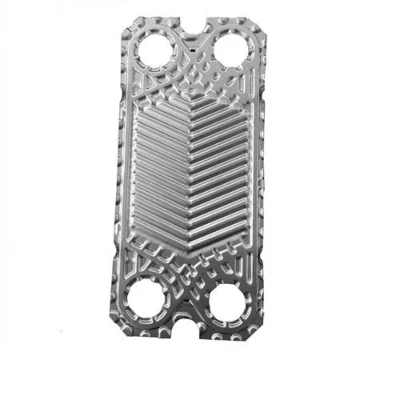
After the plate heat exchanger has operated for a period of time, a layer of white scale adheres to the wall of the heat exchanger. The main reason for the formation of scale is due to the low solubility of calcium and magnesium salts in the water, the solubility of which decreases as the water temperature rises and becomes insoluble salts. These insoluble salts will have a great impact on the heat exchange effect of the heat exchanger.
Therefore, effective anti-scaling and descaling are problems that must be solved in the normal operation of the plate heat exchanger.
1. The influence of fouling on the plate heat exchanger
The thermal conductivity of scale is very poor. It is 30-50 times smaller than the thermal conductivity of steel. The presence of scale will reduce the heat transfer capacity of the heated surface and fail to reach the ideal temperature drop. According to relevant data, the heat exchange efficiency will drop by about 10% when the scale is 1mm thick.
The scale attached to the heat transfer surface is difficult to remove, which increases the maintenance cost, not only consumes manpower and material resources, but also damages the heated surface and reduces the life of the heat exchanger.
After the scale is generated, it will reduce the flow cross section inside and outside of the heat transfer surface and increase the flow resistance of the circulating water. In severe cases, the flow cross section is very small or even completely blocked, making the heat exchanger unable to operate normally.
2. Anti-scaling treatment of plate heat exchanger
(1) Add medicine to soften treatment
According to different dosing methods, it can be divided into correction agent treatment and anti-scaling agent treatment
Corrector processing
Commonly used calibrators are NaOH, Na2CO3, NaHCO3, etc. The permanent hardness in the water reacts with the calibrator to generate sludge to prevent the permanent hardness from generating sulfate scale.
Antiscalant treatment
The commonly used anti-scaling agent is a mixture of drugs such as corrector, trisodium phosphate, tannin extract and other substances. The CO32- and PO43- that they free in the water can react with the hardness of the salt in the water to form sludge without scaling.
(2) Magnetized anti-scaling treatment
Under the action of an external magnetic field, the ions in the water change, which leads to changes in the crystallization conditions. The formed crystals are very loose, have poor compression and tensile resistance, and are very brittle. Its adhesion and adhesion are also very weak, and it is not easy to adhere to heated Scale formed on the surface.