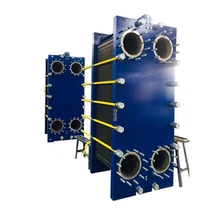
For plate heat exchangers, in the design and use of the process will always encounter the problem of low efficiency of plate heat exchangers, which involves a number of factors, to sum up, to improve the heat transfer efficiency of plate heat exchangers, from the design point of view, the following four points are the most critical:
1, Improve the surface heat transfer coefficient of the plate
As the plate heat exchanger corrugation can make the fluid in a smaller flow velocity turbulence (Reynolds number of a 150 ), so you can get a higher surface heat transfer coefficient, the surface heat transfer coefficient and the geometric structure of the plate corrugation and the flow state of the medium. The waveform of the plate includes herringbone, flat, spherical, etc.
2, Reduce the thermal resistance of the dirt layer
The key to reducing the thermal resistance of the heat exchanger fouling layer is to prevent plate fouling. Plate fouling thickness of 1 mm, the heat transfer coefficient is reduced by about 10%. Therefore, attention must be paid to monitoring the water quality on both sides of the heat exchanger hot and cold to prevent plate scaling, and to prevent the attachment of debris in the water on the plate.
3, The use of high thermal conductivity plate
Plate material can be selected from austenitic stainless steel, titanium alloy, copper alloy, etc. Stainless steel has good thermal conductivity, thermal conductivity of about 14.4 W / (m - K), high strength, good stamping performance, not easy to be oxidized, the price is lower than titanium alloy and copper alloy, the most used in heating engineering, but its ability to resist corrosion of chloride ions is poor.
4、Reduce the thickness of the plate
The design thickness of the plate has nothing to do with its corrosion resistance, and the pressure-bearing capacity of the heat exchanger. Plate thickness, can improve the pressure-bearing capacity of the heat exchanger. The use of herringbone plate combination, adjacent plates are inverted to each other, corrugated contact with each other, forming a large density, uniformly distributed fulcrum, plate angle solitaire L and edge sealing structure has been gradually improved, so that the plate heat exchanger has a good pressure-bearing capacity.