The common rubber 0-ring is a self-sealing principle, which maintains its sealing function until the 0-ring is deformed and softened. This is because it is the pressure exerted by the 0-ring that seals against small defects.
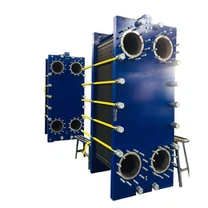
The sealing of a heat exchanger is not the same for the entire rubber sheet. The sealed operation of the heat exchanger depends primarily on a comparison between the instantaneous sealing stress caused by the compression of the rubber gasket and the operating pressure of the heat exchanger. If the sealing stress is greater than the operating pressure, the seal is maintained and if not, leakage occurs. Therefore, the most important thing for a heat exchanger seal is that the sealing stress is as high as possible and remains so for as long as possible.
This means that the rubber undergoes stress relaxation under long-term deformation, i.e. the seal stress decays with time under constant tension or pressure. Higher stress relaxation is an important factor in limiting the service life of heat exchanger rubber gaskets. There are two types of stress relaxation, one is physical relaxation, which is caused by the rearrangement between polymer molecules and filler particles, which gradually approaches equilibrium with the deformation of the rubber, and the logarithm of the sealing stress is linear with time. Another type of relaxation is chemical relaxation, which is caused by the cracking of chemical bonds in the rubber interconnection. Oxidation and temperature are important factors affecting this type of relaxation. The rate of stress relaxation is therefore very much dependent on temperature and the operating temperature range for each rubber gasket. Low temperature nitrile is suitable for the low temperature range and therefore stress relaxation deteriorates rapidly as the temperature rises, whereas the opposite is true for fluoroelastomers, which are suitable for the high temperature range.
Poorly made gaskets with low crosslink density have high stress relaxation rates and short gasket life. However, increasing the crosslink density improves the stress relaxation but reduces the tear strength of the rubber, resulting in the rupture of the rubber gasket under high stress. Sealing stress is a function of temperature, and different rubbers have different dependencies on temperature. The sealing stress of fluoroelastomers shows a strong dependence on temperature and therefore cold leaks can occur in plate heat exchangers fitted with fluoroelastomer gaskets.
In addition to stress relaxation, another often overlooked characteristic of rubber gaskets is that the physical properties are also very strongly dependent on temperature. At high temperatures, the tear strength and hardness of rubber gaskets are reduced, although the reduction varies from one rubber gasket to another, but if the gasket is then compressed and its ultimate strength is exceeded, mechanical damage to the gasket may occur, such as crushing.
The life span of a heat exchanger rubber gasket can be described as follows. The initial sealing stress is generated when the gasket is mounted on the plate and compressed to its nominal size after assembly, and the stress relaxation of the rubber gasket begins. During the period of transport storage and installation of the heat exchanger, the heat exchange temperature is low and the stress relaxation is moderate. After start-up, the temperature starts to rise and the stress relaxation becomes more severe. After a certain period of operation, the heat exchanger needs to be stopped for maintenance and cleaning, and the heat exchanger cools down again to its original temperature. After re-opening, the seal stresses and stress relaxation start again. After several repetitions, in the case of hot and cold exchange, the sealing stress of the rubber gasket is eventually reduced to below the minimum sealing stress necessary to maintain the seal and the heat exchanger begins to leak, forcing it to stop operation and be replaced with a new rubber gasket.