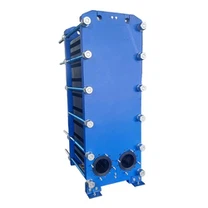
Some people may ask, why do we need to leave the bolts long? It's like when you decorate a house, if you cram all the furniture in tightly and there is no room for movement, it will be difficult to change a light bulb or repair a pipe in the future. The same is true for plate heat exchangers. First of all, this is to leave space for maintenance and cleaning. We all know that one of the great advantages of plate heat exchangers is that they are easy to disassemble for cleaning or maintenance. Just think about it, if the bolts are short, they have to be removed every time for maintenance, which is so troublesome. But now that a longer section of the bolts is reserved, it's different. The maintenance master is like having a magic key. Without completely removing the bolts, he can easily disassemble the equipment and expand a large enough space. At this time, you can carefully clean the internal plates like examining a patient, and if there is any problem with the sealing gasket, it is effortless to replace it. Just like changing a film for your mobile phone, you can easily get it done. Convenient to add or reduce plates Let's talk about the second reason, which is convenient to add or reduce plates. In actual operation, process requirements are like a child's face, changing at any time. Sometimes more heat exchange area is needed, and sometimes it has to be reduced a little. This long bolt comes in handy. It is like a flexible magician's assistant, providing great flexibility for adding or reducing plates. You just need to loosen the bolts like solving a simple puzzle, then insert or remove the plates as needed, and finally re-tighten the bolts, just like reassembling a toy, and you can easily adjust the heat exchange capacity of the equipment. It's like you are building blocks. If you want to build it higher, put a few more blocks, and if you want to build it lower, take a few blocks away. The long bolt gives us such freedom. In addition to ensuring that the plates are evenly stressed, the extended part of the bolt can also ensure even stress. This is like a tug-of-war game. If everyone's force is uneven, the rope will be crooked and the game cannot be carried out properly. The same is true for the plates of the plate heat exchanger. When reassembling, if the force is uneven, the plates will be like bullied children and will easily deform or be damaged. The extended part of the bolt is like a fair referee, which can ensure that the force is even everywhere, so that the plates can work well in their positions. This is crucial to ensure the long-term and efficient operation of the heat exchanger, just like the stable operation of the engine is as critical to a car. In addition, according to the position of the interface, the plate heat exchanger can be divided into those on the same side and those distributed on both sides. Guess what? It is usually more common to distribute on the same side. Why is that? Let's take an analogy. If you want to expand your house, if you open the doors and windows on one side, you don't have to make a big fuss to change the position of the doors and windows during the expansion. Just make sure there is enough space on the other side. The same is true for plate heat exchangers. If the interfaces are on the same side, there is no need to move the water pipes during the later expansion. You only need to ensure that there is enough expansion space on the side that is not connected. This saves costs and facilitates operation. Isn't it a smart design? So, don't underestimate this reserved longer bolt, there is a lot of knowledge hidden in it! Just like many things in life, they seem ordinary, but in fact there are profound truths and ingenious designs behind them.
Shanghai Exheat Industries Co., Ltd
+86-13545529361
 Language
- English
- Português
- Srbija jezik (latinica)
- slovenščina
- Español
- Français
- Cymraeg
- Gaeilgenah Éireann
- suomi
- Polski
- اردو
- Svenska
- عربي
- Nederlands
- Norsk
- íslenska
- Indonesia
- ไทย
- русский
- हिंदी
- slovenčina
- Català
- українська
- فارسی
- Български
- 한국어
- Bai Miaowen
- Türkçe
- Italiano
- বাংলা
- Lietuvių
- dansk
- O'zbek
- Deutsch
- Malti
- Eesti
- Việt Nam
- Čeština
- 日本語
- עברית
- Kreyòl Ayisyen
- bosanski
- magyar
- România limbi
- Latviešu
- hrvatski
- Melayu
- Ελληνικά