


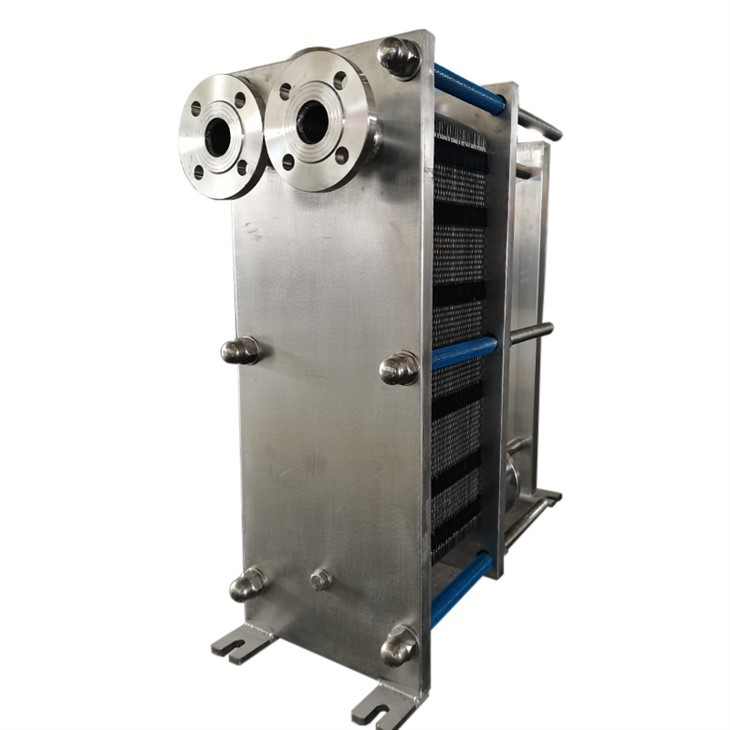


Installation and use of heat exchangers
The plate heat exchanger is divided into two types of installation according to the presence or absence of saddle brackets. The first, for the plate heat exchanger without saddle-type support, should be installed in the heat exchanger on a brick saddle-shaped foundation, after the installation of the plate heat exchanger at the moment do not need to be fixed with the foundation, the whole plate can be changed with the expansion of the free movement.
The second, for plate change with saddle support, should first be laid flat on the foundation in concrete, to be completely dry after the saddle support with the ground concrete completely fixed up with ground bolts.
During the installation of the plate heat exchanger, sufficient space should be left at the front and rear ends of the heat exchanger for maintenance and cleaning. The heat exchanger should not be operated under conditions exceeding those specified on the nameplate, and the temperature and pressure of the heat exchanger media should be inspected and analysed to prevent abnormal operation of the heat exchanger.
The heat exchange effect of the heat exchanger and the scale has a great relationship, the more scale, the less satisfactory the heat exchange effect. Therefore, the scale on the heat exchanger should be cleaned in time. In order to avoid excessive accumulation of scale affect the heat exchange effect.
Heat exchanger cleaning and daily maintenance methods
As the water contains a small amount of calcium and magnesium ions as well as bacteria and other micro-organisms, the heat exchanger will inevitably have limescale gathering on the clean plate after a long period of use, and bacteria breeding.
Limescale is due to the presence of calcium and magnesium salts in the water, and the solubility of some calcium and magnesium salts decreases as the temperature rises, and the crystalline salts that precipitate out gather and adhere to the plates to form limescale. Poor thermal conductivity of limescale, attached to the plate will inevitably affect the heat transfer effect of the plate. If not effectively cleaned for a long time, more and more scale will reduce the flow section (such as the corrugated surface of the plate in the picture), increase the flow resistance, and even block the flow section when serious.
Therefore, regular cleaning of scale is the basis for ensuring the effectiveness of plate heat exchange. The most commonly used cleaning method is the chemical cleaning sterilisation method. In the cleaning, adding chemicals and biocides, so that the plate on the scale, floating rust, bacteria and other chemical reaction with the reagents cleaning and elimination, restore the plate clean surface.
In addition, in terms of daily maintenance, corrosion and scale inhibitors can be added to prevent calcium and magnesium ions from crystallising and precipitating. Good conditions can be magnetized and ion bar anti-scaling treatment, sodium ion exchange treatment and other methods.
Hot Tags: plate heat exchanger, China, suppliers, manufacturers, cheap, pricelist, low price, for sale, Plate heat exchanger for sugar industry, heat exchangers for cooling fertilizers, plate heat exchanger leaking, Plate heat Exchangers for heating finished wine, crude oil plate heat exchanger, plate heat exchanger keeps getting blocked


