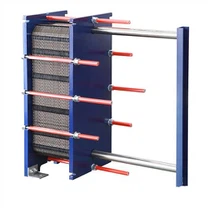
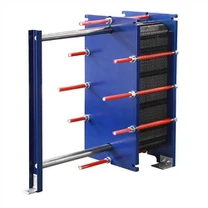
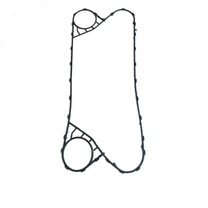
Different plate material for heat exchanger working condition
Sheet standard and thickness
Plate heat exchanger plates
AISI 304
It is usually 0.4 or 0.5 mm thick
AISI 316
Always 0.5 and 0.6 mm
254 SMO (High alloy)
Usually 0.6mm
titanium
Always 0.5 and 0.6 mm
Some have thicker plates (high pressure conditions)
Some PHEs have 0.4mm (low pressure condition)
Hastelloy C-276 (nickel alloy)
Usually 0.6mm
As the most important heat transfer link of plate heat exchanger system, the quality of plate heat exchanger directly affects the service life of equipment. Therefore, in the parameter selection design, often manufacturers will be strictly in accordance with the parameters provided by the customer for repeated design, the flow of the medium will also confirm its physical properties, to ensure the selection of the corresponding material, because the different media involved in heat transfer will be corrosive to the corresponding material sheet, so, according to the different heat transfer medium to select the appropriate material sheet is very important. To avoid leakage!
So what kind of plate should you choose for different media? Today's simple take you to understand the following:
1, water common tap water, purified water generally we choose stainless steel 304 material; So if it is well water, river water, closed circulating water and other media, we have to consider 316L, because these media components are more complex, 304 corrosion resistance is not as good as 316L. So if it is seawater, we must consider using titanium alloy material, seawater chloride ion concentration is relatively high, only titanium alloy material can meet.
2, acid dilute sulfuric acid concentration is less than 10%, the temperature is below 50℃, can use stainless steel 316L material, if greater than the need to use Hastelloy material. Phosphoric acid, hydrochloric acid is the same principle.
3. General equipment lubricating oil and hydraulic oil are made of 304 stainless steel. High temperature heat conduction oil considering high temperature resistance, we use 316L material.
4. The working condition of steam is relatively common. Generally, we choose 316L material in the south, because the temperature of steam is generally above 120℃. In the north, considering the cost performance, it will choose 304 material. Over a long time, the plate heat exchanger plates are basically deformed.