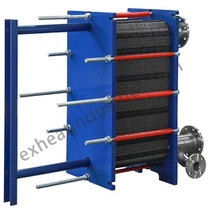
In many people's minds, stainless steel is almost synonymous with being indestructible.
So, when they see rust or perforations on the plates of a plate heat exchanger, their first reaction is often to get angry and blame the manufacturer:
"The manufacturer must have cut corners! They must have supplied fake stainless steel and lied to me about it being 304!"
In fact, stainless steel is not that invincible.
Think of it like our skin. Although it has a certain level of protection, it can still become damaged if it is constantly exposed to saltwater or acidic water.
The plates in a plate heat exchanger are very thin. Once corrosion protection is inadequate, the consequences can be serious: perforation, internal leakage, and even complete equipment failure.
If you want to protect your equipment and extend its service life, you need to understand how to prevent corrosion.
Today, let's share some essential corrosion prevention tips to help give your equipment an extra layer of protection!
1. Start at the Source: Never Cut Corners When Selecting Materials
This is the first line of defense against corrosion and also the most important one.
Many serious corrosion problems are actually determined the moment you sign the contract and purchase the equipment.
I've seen too many people choose the cheapest 304 stainless steel without giving it a second thought, regardless of how poor the water quality is or how high the chloride concentration may be, simply to save a little money.
It's like sending someone wearing a short-sleeved shirt to Antarctica. Freezing is only a matter of time.
Material selection must be based on the actual operating conditions:
- For ordinary tap water or softened water: 304 stainless steel is generally sufficient and offers a cost-effective solution.
- For well water or river water containing some chloride ions: 316L stainless steel is usually a better choice. It contains molybdenum, which gives it significantly better corrosion resistance than 304 stainless steel.
- For seawater, saltwater, or water with high chloride concentrations: Choose titanium plates (Ti) without hesitation. Although they are more expensive, titanium offers excellent corrosion resistance in many chloride-containing environments.
The money you save by choosing a lower-cost material can eventually come back to you in the form of much higher repair and maintenance costs.

2. Control the Operating Environment: Beware of the Combination of High Temperatures and Chloride Ions
What is stainless steel most vulnerable to?
One of its biggest challenges is exposure to chloride ions (salts) at high temperatures.
Together, these conditions can lead to a serious form of corrosion known as chloride-induced stress corrosion cracking.
The plates may develop unexpected cracks at the sharp corners of their corrugations, where stress is concentrated. These cracks can branch out like the limbs of a tree.
How can you prevent this?
If your water contains chloride ions, even at concentrations within the permitted limits, try to keep the operating temperature below 60°C where the process allows.
The lower the temperature, the less aggressive chloride-induced corrosion tends to be.
If your process requires high temperatures, such as above 100°C, and the water also contains chloride ions, go back to the first point: choose a more suitable, corrosion-resistant material! Don't force an unsuitable material to work under conditions it cannot withstand.
3. Clean Properly: Avoid Causing Corrosion Through Improper Cleaning
This is a problem caused entirely by human error. Many heat exchangers are not worn out through normal operation; they are damaged by improper cleaning.
When a heat exchanger becomes dirty, cleaning is necessary.
However, some people prefer to use hydrochloric acid because it seems convenient and inexpensive.
But remember: hydrochloric acid (HCl) contains chloride ions!
Using it to clean stainless steel is practically asking for trouble.
Although the scale may be removed, the protective passive film on the plate surfaces can also be severely damaged.
After cleaning, the plates may be covered with numerous small pits, bringing them one step closer to failure.
Always choose a suitable cleaning agent, such as nitric acid, formic acid, citric acid, or a specialized stainless steel cleaning solution, according to the plate material and the type of deposits.
A corrosion inhibitor must also be added when required by the cleaning procedure.
A corrosion inhibitor acts like a protective layer, helping the cleaning solution dissolve the scale while reducing its attack on the metal.
4. Keep Deposits Away: Prevent Under-Deposit Corrosion
In many cases, corrosion does not occur on the exposed surface. Instead, it develops underneath accumulated deposits.
Sand, sludge, algae, and scale can build up on the plate surfaces, creating oxygen-depleted areas.
Stainless steel relies on oxygen to help maintain and repair its protective passive film. When oxygen becomes insufficient in these localized areas, the film may break down.
In addition, acidic substances can become concentrated beneath deposits, allowing corrosion to progress unnoticed until the plates are perforated.
How can you prevent this?
- Install filters: Prevent sand and other solid impurities from entering the heat exchanger.
- Maintain adequate flow velocity: Avoid excessively slow water flow that allows deposits to settle.
- Clean regularly: If deposits are found, clean them promptly instead of allowing a minor problem to develop into a serious failure.
Final Thoughts
Corrosion prevention for plate heat exchangers comes down to four key principles:
- Choose the right material: Titanium plates are often a suitable choice for seawater applications.
- Control the temperature: High temperatures combined with chloride ions can create a serious corrosion risk.
- Clean scientifically: Never use hydrochloric acid to clean stainless steel plates.
- Remove deposits: Prevent under-deposit corrosion through filtration, proper flow conditions, and regular cleaning.
Follow these principles, and your plate heat exchanger will be much better protected against corrosion, helping it operate reliably and serve you for many more years!