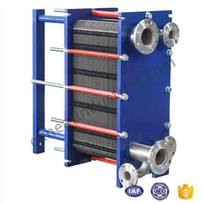
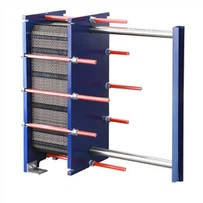
| Product Information of gasketed plate heat exchanger | |
| Item | Plate Heat Exchanger for Fuel Cell |
| Brand | Exheat |
| Plate material | Stainless steel 0.5mm 0.6mm 0.7mm 0.8mm 1mm |
| Gasket material | NBR HNBR EPDM HEPDM VITON FKM Silicone(FDA Standard) |
| Frame material | stainless steel |
| Color of frame | blue or customed color |
| Connection type | flange or thread |
| MOQ | 1 set |
| Package | polywood case |
| Warranty | one year |
The role of Plate heat exchanger in the dairy industry
Heat exchangers play a crucial role in the dairy industry by performing multiple functions throughout the production process. The main responsibilities of heat exchangers in the dairy industry include heating, cooling, pasteurization, and sterilization of dairy products.
Heating: Milk needs to be heated for various purposes like killing bacteria, improving product quality, etc. Heat exchangers are used to heat milk before processing it for cheese, yogurt, and other dairy products. A heat exchanger ensures that milk is heated uniformly and efficiently to the desired temperature without affecting its chemical composition.
Cooling: Cooling is a critical process in the dairy industry, especially when milk is being transported or stored. Heat exchangers are utilized to cool milk quickly to its storage temperature, thereby preventing bacterial growth. It also helps to maintain product quality by minimizing the rate of chemical and enzymatic reactions that occur during storage.
Pasteurization: Pasteurization is an essential process in the dairy industry where milk is heated to a specific temperature to kill harmful bacteria without affecting the product quality. A heat exchanger is an ideal solution to pasteurize milk as it efficiently heats the milk to the required temperature and cools it down rapidly, ensuring minimal nutrient loss while maintaining the taste and texture of the dairy product.
Sterilization: Heat exchangers also play a crucial role in sterilizing dairy products. They are used for ultra-high-temperature (UHT) treatment of milk, which makes the milk shelf-stable for an extended period. This process involves heating milk to a temperature higher than 135°C and then quickly cooling it down. A heat exchanger ensures that milk is exposed to high temperatures for a brief period while ensuring minimal nutrient loss.
In summary, heat exchangers are essential equipment in the dairy industry, providing heating, cooling, pasteurization, and sterilization capabilities. These functionalities play an essential role in ensuring that dairy products are safe for consumption and maintain their quality for an extended period.
Hot Tags: plate heat exchanger for dairy industry, China, suppliers, manufacturers, cheap, pricelist, low price, for sale, heat exchanger analysis, 80 plate heat exchanger, plate heat exchanger kaori, bosch gb162 plate heat exchanger 80 100w, plate heat exchanger lmtd, plate to plate heat exchanger