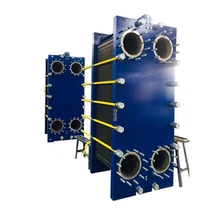
Introduction: As an important equipment in industrial production, the operating efficiency of the heat exchanger is directly related to the enterprise's energy consumption and production costs. So, how to buy, design and maintain the heat exchanger to achieve its efficient operation? This article will provide you with a detailed heat exchanger efficient operation strategy to help you give full play to the potential of the heat exchanger, reduce operating costs.
First, the purchase and design strategy
1, balance pressure drop and pump costs
In the purchase of heat exchangers, to fully consider the maximum pressure drop allowed in the system. The right pressure drop to ensure that the heat exchanger in a highly efficient state of operation, while avoiding excessive pump costs. It should be noted that too low a pressure drop may lead to heat exchanger performance limitations, additional plates to increase the number of channels, thereby increasing the pressure drop.
2, select the appropriate orifice size
When designing a heat exchanger, try to achieve efficient heat transfer in the channels to avoid excessive pressure drop at the corner orifice. A proper design allows very small pressure drops to occur in the corner holes. For this reason, it is crucial to choose the right orifice size.
3, Ensure the appropriate flow rate
Fluid velocity in the heat exchanger has an important impact on the heat transfer effect. Appropriately high fluid velocities can promote turbulence and achieve better heat transfer and resistance to scale build-up. However, low flow rate may lead to heat exchanger surface scaling, reducing heat transfer efficiency.
4, the pursuit of high shear
When designing a heat exchanger, consider the shear force. Higher shear force helps the heat exchanger to self-clean and keep the equipment clean.
5, avoid the use of fouling coefficient
Unlike shell and tube heat exchangers, plate heat exchangers are not suitable for the use of fouling coefficients. Use 10% surface margin instead of the fouling factor to ensure that long-term scaling problems are solved.
Second, cleaning and optimisation recommendations
1, monitoring heat exchanger performance
Regularly monitor heat exchanger operating parameters such as temperature, pressure drop and flow rate in order to understand the equipment operating conditions. By creating temperature and pressure drop graphs, changes in heat exchanger performance can be visualised.
2, Keep the heat exchanger clean
Cleanliness of the heat exchanger is essential to maintain efficient heat transfer. Regular cleaning of the heat exchanger to remove accumulated dirt will help improve equipment performance. According to the use of the heat exchanger, develop a suitable cleaning plan.
3. Analyse potential areas for improvement
Evaluate the possibility of improving fluid flow rates and seek expert analysis to identify opportunities for heat exchanger optimisation. The performance of the heat exchanger can be improved by adjusting process or system parameters.
Summary
The efficient operation of a heat exchanger is dependent on sound purchasing, design and maintenance strategies. From balancing pressure drop and pump cost when purchasing, to orifice size and velocity when designing, to cleaning and optimisation, every aspect needs to be fully considered. Only in this way can the heat exchanger give full play to its maximum potential and reduce operating costs for the enterprise.