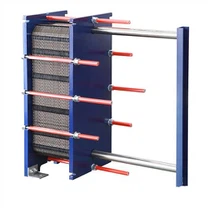
Under normal circumstances, we mainly distinguish plate heat exchangers based on the structure, that is, according to the shape, which can be divided into four categories: ①Removable plate heat exchangers (also called plate heat exchangers with gaskets), ② Welded plate heat exchanger, ③ Spiral plate heat exchanger, ④ Plate coil heat exchanger (also called honeycomb heat exchanger).
Among them, the welded plate heat exchanger is divided into: semi-welded plate heat exchanger, fully welded plate heat exchanger, plate and shell heat exchanger, and brazed plate heat exchanger.

The frequently used classifications are as follows:
1 According to the amount of heat exchange area in the unit space, plate heat exchangers are compact heat exchangers. Compared with shell-and-tube heat exchangers, traditional shell-and-tube heat exchangers occupy a larger area.
2 According to the process usage, there are different names: plate heater, plate cooler, plate condenser, plate preheater;
3 According to the process combination, it is divided into single-pass plate heat exchanger and multi-pass plate heat exchanger;
4 According to the flow direction of the two media, it is divided into co-current (cocurrent) plate heat exchanger, counter-current plate heat exchanger, and cross-flow (cross-flow) plate heat exchanger, the latter two are more used;
5 According to the gap size of the runner, it is divided into conventional gap plate heat exchanger and wide gap plate heat exchanger;
6 According to the corrugation, there are more detailed differences in plate heat exchangers, which will not be repeated, please refer to: plate heat exchanger corrugated form.
7 According to whether it is a complete set of products, it can be divided into stand-alone plate heat exchanger and plate heat exchanger unit.