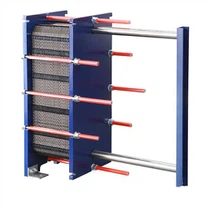
1. The suspension of the plates of the plate heat exchanger adopts a "dovetail" design to avoid deformation of the plates due to their own weight and extrusion.
2. The plates of the plate heat exchanger adopt mutual locking function, which can be fixed to each other.
3. The four sides of the plates of the plate heat exchanger have a "honeycomb" design, which makes it easy for users to recognize the correctness of the plate installation.
4. The sealing gasket of the plate heat exchanger adopts a cassette-type adhesive-free type, which can greatly save future maintenance time (saving time to replace the gasket 1/4).

5. The sealing gasket of the plate heat exchanger is designed in a "trapezoid shape", which can enhance the service life of the gasket.
6. There are evenly distributed complex patterns on the plates of the plate heat exchanger. The entire plate is divided into multiple parts, each part of the pattern has a different angle, and a variable flow channel is formed on the entire plate in overlapping contact. The pattern design of the plate has gone through computer simulation and simulated actual operation experiment to ensure efficient heat exchange efficiency.
7. Due to the influence of the plate pattern, obvious turbulence is formed in the flow channel, and the water is not easy to form scale on the surface of the plate, even if the scale occurs, it is very easy to be washed away by the water flow.