Leakage
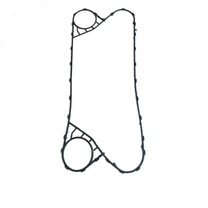
Cause: ①The clamping size is not in place, the size is uneven everywhere (the size deviation should not be greater than 3 mm) or the clamping bolt is loose. ② Part of the gasket is out of the sealing groove, the main sealing surface of the gasket is dirty, the gasket is damaged or the plate heat exchanger gasket is aging. ③ The plate is deformed, and the assembly misalignment causes the running mat. ④ There are cracks in the plate sealing groove or the second sealing area. Example: Many thermal stations in Beijing, Qinghai, Xinjiang and other places use saturated steam as the primary heat source for heating. Due to the high steam temperature, when the system is unstable at the initial stage of equipment operation, the rubber gasket fails at high temperature, causing Steam leaks.
Treatment method: ① In the no-pressure state, re-clamp the equipment according to the clamping size provided by the manufacturer. The size should be uniform, and the deviation of the compacted size should not exceed ±0.2N (mm) (N. is the total number of plates) , The parallelism between the two compression plates should be kept within 2 mm. ② Make a mark on the leaking parts, then disassemble the heat exchanger and investigate and solve them one by one, and reassemble or replace the gaskets and plates. ③ Disassemble the heat exchanger, repair the deformed part of the plate or replace the plate. When there is no spare part for the plate, the plate at the deformed part can be temporarily removed and then reassembled for use. ④ When reassembling the disassembled plates, clean the plate surface to prevent dirt from adhering to the gasket sealing surface.
Liquid
Causes: ① Due to improper plate selection, cracks or perforations are caused by plate corrosion. ②The operating conditions do not meet the design requirements. ③ The residual stress after cold stamping of the plate and the clamping size during assembly are too small to cause stress corrosion. ④ There is a slight leakage in the plate leakage groove, which causes the harmful substances in the medium (such as C1) to concentrate and corrode the plates, forming a stream of liquid. Example: A BR03 plate heat exchanger with a plate material of 254 SMo in a sulfuric acid system of an aluminum industry Co., Ltd. experienced corrosion and leakage of the carbon steel pipe on the cooling water side after 5 months of operation, and the acid leaked to the cooling water side. The inspection found that there was serious corrosion and cracking at the plate acid inlet and diversion area. On-site analysis found that the system operating temperature, flow rate and concentration and other process parameters are beyond the design conditions, and the use temperature far exceeds the applicable range of the material. Plate heat exchangers that use saturated steam as the primary heat source are prone to plate corrosion during operation, resulting in product leakage. This is because the steam temperature is high, and it is easy to cause the rubber gasket to fail at high temperatures during the operation of the equipment, causing the steam to leak out and rapidly condense in the second sealing area. As the leakage continues, the condensed residual liquid will accumulate more and more, locally forming areas with higher cl mass concentration, and reaching the corrosion conditions that destroy the passivation layer on the surface of the plate. At the same time, since the internal stress formed by cold stamping of the plate in this area is relatively large, when the surface passivation layer is destroyed, the internal stress causes the occurrence of stress corrosion.
Treatment method: ① Replace the cracked or perforated plate, and use the light transmission method to find the crack of the plate on the spot. ②Adjust the operating parameters to meet the design conditions. ③The clamping size of the heat exchanger should meet the requirements during maintenance and assembly, not as small as possible. ④The plate heat exchanger plate materials are reasonably matched.