01
Principles of setting up heat exchange station
1, to the overall plan for centralized heat exchange station setup based on the program should be developed to avoid duplication of construction, so that the future development and current use of a close combination. Do a good job of macro-control, co-ordination of construction projects to achieve a unified layout.
2, the design of the heat station should be its indoor heat system and outdoor heat network factors are taken into account. For the pressure and design temperature should be consistent with the design requirements, heat station equipment and systems and outdoor heat network should match each other.
3, the heat exchange station should be set in the center of the heat load density is relatively large, and to make the load area as far as possible not across the main street, usually less than 1000 m heating radius.
4, should be through the technical and economic to determine the size of the heat transfer station, in order to make it easy to operate and manage, the size of the heat transfer station should be controlled as far as possible in the supply of 50,000m2 ~ 200,000m2 within the scope of the load.
02
Theory of the construction scale of the heat exchanger station
1, to the overall planning for centralized heat transfer station set up based on the program should be developed to avoid duplication of construction, so that the future development and current use of a close combination. Do a good job of macro-control, co-ordination of construction projects to achieve a unified layout.
2, the design of the heat station should be its indoor heat system and outdoor heat network factors are taken into account. For the pressure and design temperature should be consistent with the design requirements, heat station equipment and systems and outdoor heat network should match each other.
3, the heat exchange station should be set in the center of the heat load density is relatively large, and to make the load area as far as possible not across the main street, usually less than 1000 m heating radius.
4, should be through the technical and economic to determine the size of the heat transfer station, in order to make it easy to operate and manage, the size of the heat transfer station should be controlled as far as possible in the supply of 50,000m2 ~ 200,000m2 within the scope of the load.
03
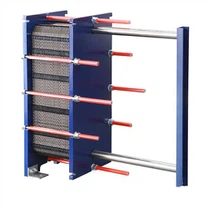
Selection of heat exchanger
In the selection of heat exchangers, we need to work for different requirements for selection. For example, for different areas and management structure in operation.
1, heat exchanger heat transfer area:
In the design process for the heat exchanger heat transfer area, it should be noted that in the calculation, the use of different heat loads, will have a different degree of impact, which requires the design staff to carry out an accurate data analysis, according to the selection of different buildings with reasonable heat loads, and then calculate the design, which also reduces the heat exchanger accounting and calculation of the problem of the fundamental.
2, heat exchanger operation with the management :
In the centralized treatment of urban buildings in the format management, the need for different heat exchanger equipment for a certain selection, for the equipment encountered at the beginning of the design of the demand for the problem, you can be based on the different needs of the system for the reliability of the analysis, which ensures that the selection of heat exchanger on the different forms of heat exchangers can effectively ensure the reasonable operation of its structure. And in the setup of the investigation of the failure, but also better for its total load for the corresponding data analysis. Only to determine the structure of the reasonable, can more effectively ensure that the heating process of the function is suitable for the heating needs of the district.
In the selection of heat exchanger, we mainly focus on the loss of heat exchanger, reduce the loss of the equipment itself, to alleviate the long-term operation of the depreciation, so as to extend the service life of the machinery.
04
Selection of operation connection
1, mixed water direct connection:
Mixed water connection commonly used in the form of water mixing including pump water supply pressurization, pump return water pressurization and pump bypass pressurization in three forms.
(1) pump water supply pressurized water mixing heat transfer, can be installed in the secondary network of water supply mixing pump. Under the action of the control valve primary network and secondary network return water for mixing, and then pumped by the pump into the secondary network, and then its heat treatment. This system is suitable for use in the primary network and secondary network water pressure is roughly equivalent, and the primary network water supply pressure is low.
(2) pump return water pressurized water mixing heat transfer, you can install a mixing pump in the secondary network of the return pipe location. Pump in the secondary network for the return water pressurization, so that the need to implement the mixed water heat transfer water in the bypass pipe valve regulation and primary network water supply mixing heating. This way is suitable for use in a network water supply pressure is relatively high but the pressure of the secondary network back to the lower conditions.
(3) pump bypass pressurized form of water mixing heat transfer, can be installed in the primary network water supply location of electric control valves, water mixing bypass pipe in the installation of water mixing pumps, this form of installation in the high-pressure section of the primary network water supply is applicable.
2,