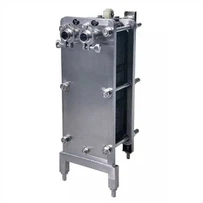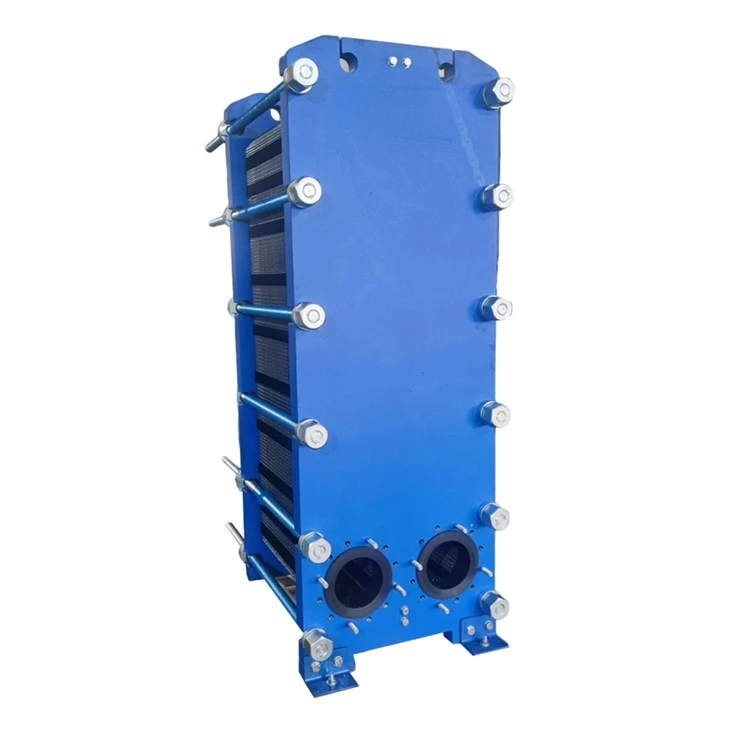
Products Description
Exheat gasketed plate heat exchangers are specifically designed for bleaching processes in the pulp and paper industry, where accurate temperature control and corrosion resistance are essential. Our heat exchangers provide efficient heat transfer for oxygen delignification, hydrogen peroxide bleaching, chlorine dioxide bleaching, and other chemical treatment stages. By optimizing thermal efficiency and reducing energy consumption, they help improve production stability while lowering operating costs.
| Product Information of Gasketed Plate Heat Exchanger | |
| Brand | Exheat |
| plate material | Titanium/Stainless steel 0.5 mm 0.6 mm 0.7 mm 0.8 mm 1 mm |
| Gasket material | NBR HNBR EPDM HEPDM VITON FKM Silicone |
| Frame material | Painted Carbon steel or stainless steel |
| Color of frame | Blue or custom color |
| Connection type | Flange or thread |
| Flange standard | ANSI ASME BS BA JIS DIN GB ISO |
| Tightening bolt | M24 M30 M39 |
| Design pressure | highest 20mpa, lowest 10Mpa |
| Work pressure | normal 12.5Mpa |
| MOQ | 1 set |
| Package | polywood case |
| Warranty | one year |
| OEM | Can make replacement |
Application of plate heat exchanger in bleaching technology
Plate heat exchangers are widely used in the bleaching technology industry due to their high efficiency and low operating costs. Bleaching technology is a process used in the pulp and paper industry to remove impurities from wood pulp, resulting in a brighter and more uniform final product.
Plate heat exchangers are used in the bleaching process to control temperature and pressure in various stages of the process. In the first stage, known as oxygen delignification, wood pulp is treated with oxygen and alkali to remove lignin. This process requires high temperatures and pressures, which can be efficiently controlled using plate heat exchangers.
In the second stage, known as hydrogen peroxide bleaching, wood pulp is treated with hydrogen peroxide and an alkali to further remove impurities. Plate heat exchangers are used to control the temperature and pressure of the mixture, ensuring optimal reaction conditions and efficient removal of impurities.
In the final stage, known as chlorine dioxide bleaching, wood pulp is treated with chlorine dioxide to further whiten the pulp. Plate heat exchangers are used to control the temperature and pressure of the mixture, ensuring efficient removal of impurities while minimizing the use of chemicals.
Overall, plate heat exchangers are essential in the bleaching technology industry due to their ability to efficiently control temperature and pressure, resulting in a high-quality final product while minimizing operating costs.
Common Challenges in Bleaching Systems
Bleaching systems often operate under corrosive and high-temperature conditions. Common operational challenges include:
- Heat loss during chemical processing
- Unstable process temperature
- Scaling and fouling
- High steam consumption
- Difficult equipment maintenance
Our gasketed plate heat exchanger helps improve thermal efficiency while reducing maintenance frequency and operating costs.
FAQ
Hot Tags: plate heat exchanger for bleaching technology, China, suppliers, manufacturers, cheap, pricelist, low price, for sale, 80kw plate heat exchanger, Plate heat Exchangers for heating finished wine, heat exchangers for cooling fertilizers, Oil Cooling Plate Heat Exchanger, k value plate heat exchanger, plate heat exchanger kaori