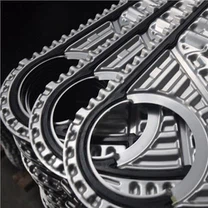
Plate heat exchanger sealing gasket can be divided into 3 forms according to the different installation methods:
(1) Direct paste type, that is, after applying sealant on the sealing gasket, it will be directly glued in the mounting groove of the heat exchanger plate sheet.
(2)Glue nail inlay type, that is, the heat exchanger plate sheet is designed with assembly holes, and there are glue nails designed on the side of the sealing gasket, and after the sealing gasket is put into the mounting groove, the glue nails will be inlaid in the assembly holes.
(3) Buckle mounted, is for the above three ways, paste type sealing gasket structure is simple, processing is easier, but the installation and disassembly is relatively troublesome. Inlaid and buckle type sealing gasket structure is complex, processing is more troublesome, but the installation and disassembly is relatively easy. Plate heat exchanger gasket according to the shape of the product profile is divided into symmetrical and asymmetrical shape, symmetrical shape is generally used in diagonal flow of the plate, the upper and lower sealing surfaces are flat, along the level of the symmetry, can be installed positive and negative. Asymmetric shape of the ground for the plane, the upper sealing surface can be flat, curved surface, bevelled, etc. in the sealing gasket edge design has buckle nails, with buckle nails will be installed in the sealing gasket buckle heat exchanger plate sheet.
For the above three ways, paste type gasket structure is simple, processing is easier, but installation and disassembly is relatively troublesome. Inlaid and buckle sealing gasket structure is complex, processing is more troublesome, but installation and disassembly is relatively easy. Plate heat exchanger gasket according to the shape of the product profile is divided into symmetrical and asymmetrical shape, symmetrical shape is generally used in diagonal flow of the plate, the upper and lower sealing surfaces are flat, along the level of the symmetry, can be installed positive and negative. Asymmetric shape of the ground for the plane, the upper sealing surface can be flat, curved surface, bevelled surface, etc.
Different applications, plate heat exchanger gasket form is different, as if the user wants to get a higher heat transfer efficiency, the general use of the gasket will be used in the form of diagonal flow; if you want to save money, it will be used in the form of unilateral flow, and so on, the following to learn more about plate heat exchanger gaskets in different occasions of the specific form of performance it! Plate heat exchanger plate according to its heat transfer medium flow form is divided into unilateral flow and diagonal flow, correspondingly, plate heat exchanger sealing gasket according to the heat transfer medium flow form is divided into unilateral flow and diagonal flow
Plate heat exchanger gasket unilateral flow refers to the heat transfer plate from the right side of the corner hole flow into the heat transfer medium from the right side of the corner hole outflow, similarly, from the left side of the corner hole flow into the heat transfer medium from the left side of the corner hole outflow. Diagonal flow means that the heat transfer fluid flows in from the right corner hole and out from the left corner hole, or the fluid flowing in from the left corner hole flows out from the right corner hole, showing a diagonal flow pattern. From the heat transfer efficiency, diagonal flow is better than one-sided flow, but the cost of using one-sided flow is relatively low, so in the case of heat transfer efficiency can be met, the general use of one-sided flow form.