Why does limonene make balloons explode? "It is possible that a rubber swelling process occurred here."
Experts further revealed that limonene is a type of olefin, and the main monomers of synthetic rubber are various olefins. Their structures are similar. When the two meet, limonene acts as a "solvent" to swell the rubber.
“When a rubber balloon is partially exposed to organic matter such as limonene, this part of the rubber will be swollen and its strength will be reduced. The rubber will become uneven and rupture under the action of the internal air pressure of the balloon. At this time, the filled gas inside will be released in a very short time. It bursts out of the breach within a certain time - the balloon bursts."
Note that it bursts! Rather than an explosion that combines sound, light, heat and other intense chemical reactions!
Uh... Although it's not an explosion, it's quite scary to watch the news. What if we touched the balloon just after eating the orange...
This kind of swelling phenomenon will also occur during the use of plate heat exchangers. Although it will not explode under normal circumstances, it will also cause leakage of the plate heat exchanger and bring harm to our production and life.
Everyone knows that plate heat exchangers have the characteristics of high heat exchange efficiency, small material flow resistance loss, compact structure, sensitive temperature control, great operational flexibility, easy assembly and disassembly, and long service life. They are currently the most advanced high-efficiency and energy-saving heat exchangers. equipment. It has been widely used in many fields such as metallurgy, mining, petroleum, chemical industry, electric power, medicine, food, chemical fiber, textile, papermaking, shipbuilding and central heating. Moreover, there are more and more types of plate heat exchangers, their technical performance is getting better and better, and their application range is getting wider and wider.
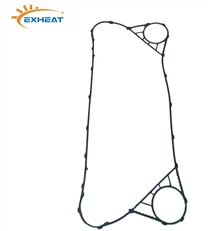
Rubber sealing gasket is a very important and demanding part of plate heat exchanger.
The gasket must not only seal the medium from leaking to the outside environment, but also prevent mixing of heat exchange media.
If the gasket swells and loses its elasticity, the heat exchanger may not operate properly.
First, let’s understand the dissolution and swelling of rubber
Dissolution and swelling of rubber
Unvulcanized rubber is soluble in solvents with similar solubility parameters. For vulcanized rubber, since chemical cross-linking connects the rubber macromolecules into a three-dimensional network structure, it can only absorb the solvent in the solvent and gradually expand and reach an equilibrium value (maximum swelling). This phenomenon is called "swelling" of rubber. The swollen volume can reach several times the volume of rubber. and is accompanied by a loss of mechanical strength. The maximum swelling of vulcanized rubber is related to its cross-link density. When absorbing solvent, the cross-linked network of the vulcanized rubber also expands to generate an elastic contraction force that squeezes the solvent out of the network. When the pressure of solvent diffusion and penetration is equal to the elastic contraction force of the cross-linked network, the swelling balance is reached.
Since the depth of liquid immersed in rubber is a function of the square root of the contact time, even if the rubber has no special resistance to the liquid it contacts, or the rubber product itself has a certain volume, it will have a certain impact on its service life.
Reasons for swelling of rubber sealing gasket of plate heat exchanger
1. Due to the medium, different temperatures, different concentration values, and different media require the use of rubber gaskets of different materials. For example, high-temperature heat transfer oil requires acid and alkali-resistant NBR strips, water EPDM strips are enough. If the high-temperature heat transfer oil must use EPDM strips, swelling of the strips is unavoidable. Therefore, appropriate gasket materials must be selected according to the different characteristics of the medium.
2. Improper selection of cleaning agent. Because plate heat exchangers generally have high heat exchange temperatures (especially steam-water exchange) and high heat exchange efficiency, they are prone to scaling. At the same time, the internal circulation pores of the plate heat exchanger are small. After scaling, the internal channel cross-section becomes smaller or even blocked, resulting in a reduction in the heat exchange efficiency of the plate heat exchanger, thus affecting the normal production and the safety of the equipment. The plate heat exchanger must be chemically cleaned regularly to remove dirt to ensure efficient heat exchange and normal production of the plate heat exchanger. The additives of many cleaning agents contain polyetheramine (PEA), a chemical substance that dissolves dirt. It has very strong detergency and solubility, and can easily cause the rubber sealing gasket to swell. Remember when choosing a cleaning agent, first choose one that is harmless to the rubber seal.
Rubber gaskets used in organic solvents such as benzene, ketone, and ether are prone to swelling, weight gain, softening, and stickiness, leading to sealing failure. Generally, it cannot be used if the swelling degree exceeds 30%.
Once the rubber sealing gasket swells, it relatively loses its original physical and chemical properties, especially its physical properties. It means that the structure of the rubber changes (aging) and loses physical properties. Once it is removed from the solvent environment, the swelling cannot be restored, and the rubber sealing gasket becomes invalid and cannot be reused!